
Ancient Humans Built Wooden Structures 200,000 Years Before Modern Humans Existed
Archaeologists have uncovered wooden structures dating back 476,000 years, revealing that early humans were master builders long before Homo sapiens emerged. This groundbreaking discovery at Kalambo Falls completely rewrites our understanding of ancient human capabilities.
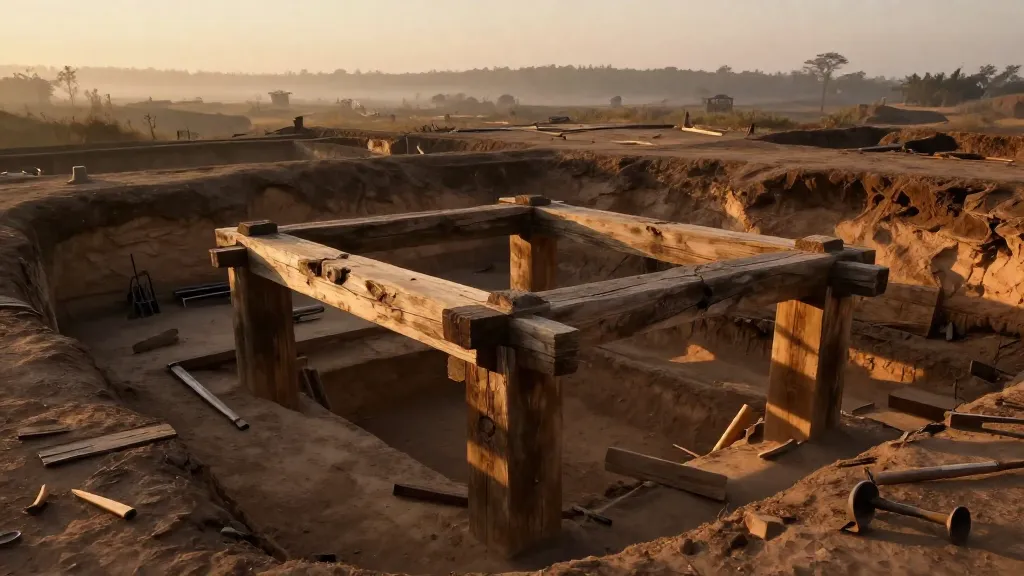
Nearly half a million years ago, long before our species even existed, early humans were already master builders. A groundbreaking archaeological discovery has revealed wooden structures dating back 476,000 years—pushing back the timeline of human construction capabilities by an astounding 200,000 years before modern humans walked the Earth.
This revelation fundamentally challenges everything we thought we knew about the cognitive abilities and technical skills of our ancient ancestors. The implications are staggering: while we’ve long assumed sophisticated building was a relatively recent human innovation, our predecessors were apparently constructing wooden frameworks when the world looked completely different.
The Kalambo Falls Discovery
The ancient wooden structures were uncovered at Kalambo Falls, where archaeologists made what may be one of the most significant prehistoric discoveries in recent memory. The site has yielded evidence that early humans possessed far more advanced construction abilities than previously imagined.
The dating of these structures to approximately 476,000 years ago places them in a time period that predates Homo sapiens by roughly 200,000 years. This means whatever human ancestors built these wooden frameworks, they weren’t modern humans as we know them today.
Rewriting Human History
This discovery forces archaeologists and anthropologists to completely reconsider their assumptions about early human intelligence and capabilities. The traditional timeline of human technological development has been turned upside down.
What This Means for Our Understanding
The existence of wooden structures from this period suggests several remarkable possibilities:
- Early humans possessed sophisticated planning and engineering skills much earlier than believed
- Tool-making abilities were far more advanced in prehistoric times
- Complex construction projects required coordinated group effort and communication
- Our ancestors had developed methods for working with wood that have been lost to time
The implications extend beyond just construction techniques. Building wooden structures requires forward-thinking, spatial reasoning, and the ability to envision a finished project—cognitive abilities that researchers are now realizing emerged much earlier in human evolution than previously thought.
Challenging Archaeological Assumptions
This discovery at Kalambo Falls represents more than just an interesting artifact—it’s a paradigm shift that forces the scientific community to reevaluate fundamental assumptions about prehistoric human capabilities.
The wooden structures predate what archaeologists previously considered the earliest evidence of sophisticated human construction by an enormous margin. This gap in the timeline suggests there may be many more discoveries waiting to be uncovered that could further revolutionize our understanding of ancient human achievements.
The Bigger Picture
The significance of this find extends far beyond the structures themselves. It opens up entirely new questions about what other advanced capabilities early humans might have possessed that have been lost to time or simply haven’t been discovered yet.
As researchers continue to analyze the Kalambo Falls site and search for similar evidence elsewhere, we may find that our ancient ancestors were far more sophisticated than we ever imagined. The story of human development is clearly far more complex and fascinating than the simplified timeline we’ve been working with.
This discovery serves as a powerful reminder that there’s still so much we don’t know about our own species’ remarkable journey through time—and that our ancestors may have been achieving incredible feats long before we gave them credit for such capabilities.