
Peak Glacier Extinction: Up to 4,000 Glaciers Could Vanish Every Year by Mid-Century
A landmark study reveals the world is heading toward catastrophic glacier loss, with up to 4,000 glaciers disappearing annually by 2050 if emissions continue unchecked. The findings show climate change doesn't just melt ice—it erases entire glaciers forever.
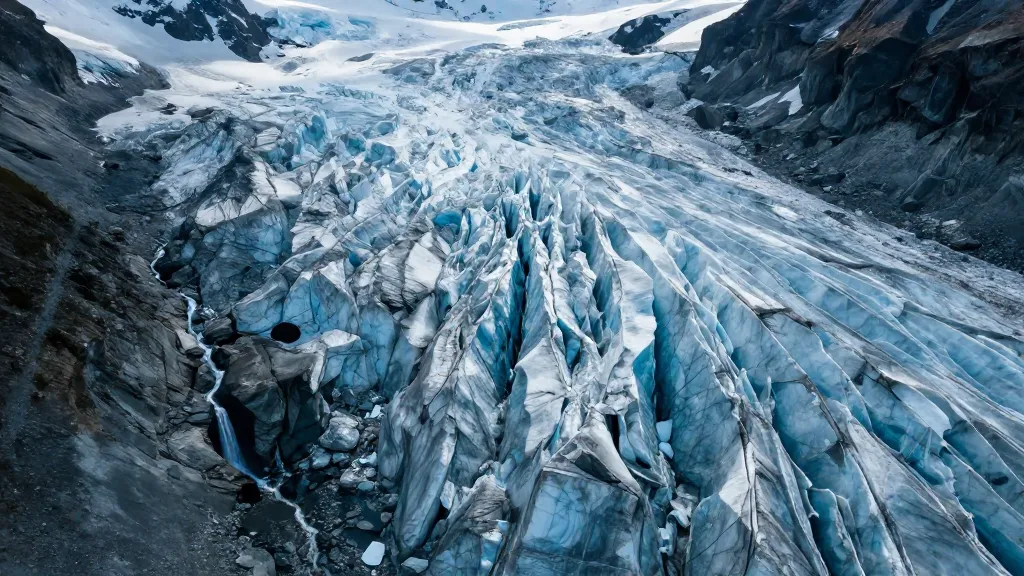
We’re witnessing the end of an era. In 2019, hundreds gathered in Switzerland to attend a funeral—not for a person, but for Pizol, a 700-year-old glacier reduced to scattered chunks of ice by climate change. It was a symbolic goodbye to a frozen landmark. But Pizol is just one casualty in what scientists now warn could become a catastrophic mass extinction event. New research published in Nature Climate Change reveals that by mid-century, up to 4,000 glaciers could vanish every single year if emissions continue unchecked—equivalent to losing all the glaciers in the European Alps in just twelve months.
The Silent Crisis Nobody’s Talking About
Most climate conversations focus on melting ice sheets and rising sea levels. But researchers have uncovered something more alarming: climate change doesn’t just reduce glaciers—it erases them entirely. There are currently more than 200,000 glaciers on Earth, and scientists have mapped exactly when and where they’ll disappear.
Matthias Huss, a glaciologist at ETH Zürich who attended Pizol’s funeral, emphasizes the distinction: “Climate change does not just lead to some ice melt, but it leads to the complete extinction of many glaciers.” This isn’t about smaller glaciers; it’s about complete, permanent loss.
When Peak Extinction Hits
The study identified a critical turning point called “peak glacier extinction”—the period when the most glaciers will vanish. The timing depends entirely on how much we heat the planet.
Different Warming Scenarios, Different Timelines
- At 1.5°C warming: Peak extinction around 2041, roughly 2,000 glaciers per year
- At 2.7°C warming: Peak extinction between 2040-2060, around 3,000 glaciers per year
- At 4°C warming: Peak extinction mid-2050s, around 4,000 glaciers per year (3 to 5 times current loss rates)
The world is currently on track for approximately 2.7 degrees of warming if current climate pledges are met—putting us squarely in the middle scenario.
Geography of Disappearance
The extinction won’t happen uniformly. Regions with smaller glaciers face the most immediate crisis.
What to Watch For
- European Alps, Andes, and North Asia will lose more than half their glaciers within two decades
- Peak extinction in these regions expected around 2040
- Greenland and Russian Arctic glaciers will persist longer but face delayed, prolonged decline
- By 2100, only 20% of glaciers remain under 2.7°C warming (versus 50% at 1.5°C)
The Domino Effect Nobody’s Ready For
Glaciers aren’t just beautiful—they’re essential infrastructure. Millions of people depend on glacier-fed water for drinking, agriculture, and hydropower. Communities in the Himalayas, Andes, and Alps face potential water crises as these frozen reserves vanish.
Beyond water security, entire economies hang in the balance. Ski resorts, glacier tourism, and alpine communities built around these landscapes face existential threats. Tourism itself has become desperate—people are rushing to see glaciers before they disappear, with some trips turning deadly as conditions destabilize.
There’s also a cultural dimension often overlooked. For indigenous and local communities, glaciers hold deep spiritual and traditional significance. Their disappearance represents erasure of heritage, not just ice.
The Point of No Return
Eric Rignot, a professor of Earth system science at UC Irvine, underscores the permanence: “It is a point of no return, because reforming a glacier would take decades if not centuries.”
This matters psychologically too. While abstract temperature increases feel distant, glaciers are visceral. They’re visual proof of climate change in a way statistics can’t match. As Harry Zekollari, a study author and glaciologist at Vrije Universiteit Brussel, notes: “If you go to someone on the street about the fact that temperatures have risen by 2 degrees, it’s really difficult to picture, but glaciers, they’re so visual.”
The Choice Ahead
The difference between 2,000 and 4,000 glaciers vanishing annually isn’t random—it’s the direct result of policy choices happening right now. Every tenth of a degree of warming we prevent saves thousands of glaciers from extinction. Every renewable energy investment, every emission reduction target, every climate commitment either accelerates or slows this countdown.
The funeral bells for Earth’s glaciers are already tolling. The question is whether we hear them in time to change the outcome.