
Humans Aren't Alone: Scientists Discover Other Primates Face Even Tighter Birth Constraints
A landmark Nature study analyzing 29 primate species reveals that difficult childbirth isn't uniquely human—and some species face even tighter biological constraints. The findings challenge long-held assumptions about what makes human reproduction distinctive.
We’ve long believed that difficult childbirth is a uniquely human burden—a painful consequence of our large brains and upright posture. But a sweeping new analysis of 29 primate species suggests we’ve been telling ourselves an incomplete story. Scientists have discovered that humans aren’t alone in facing the biological squeeze of childbirth, and some of our closest and more distant relatives face constraints that are just as tight, or even tighter.
The Study That Challenges a Cherished Assumption
Researchers recently published findings in Nature examining cephalopelvic proportions—essentially, how snugly a fetus fits through the birth canal relative to the mother’s pelvis—across dozens of primate species. What they found was striking: the notion that humans uniquely struggle with this biological bottleneck is a myth.
The analysis included 29 extant primate species, offering an unusually comprehensive look at how reproduction shapes bodies across our order. Instead of confirming human exceptionalism, the data revealed a more complex picture: tight cephalopelvic fits are scattered across the primate family tree, and in some cases, other species are squeezed even more tightly than we are.
Not Just Humans: Meet the Other Squeezed Species
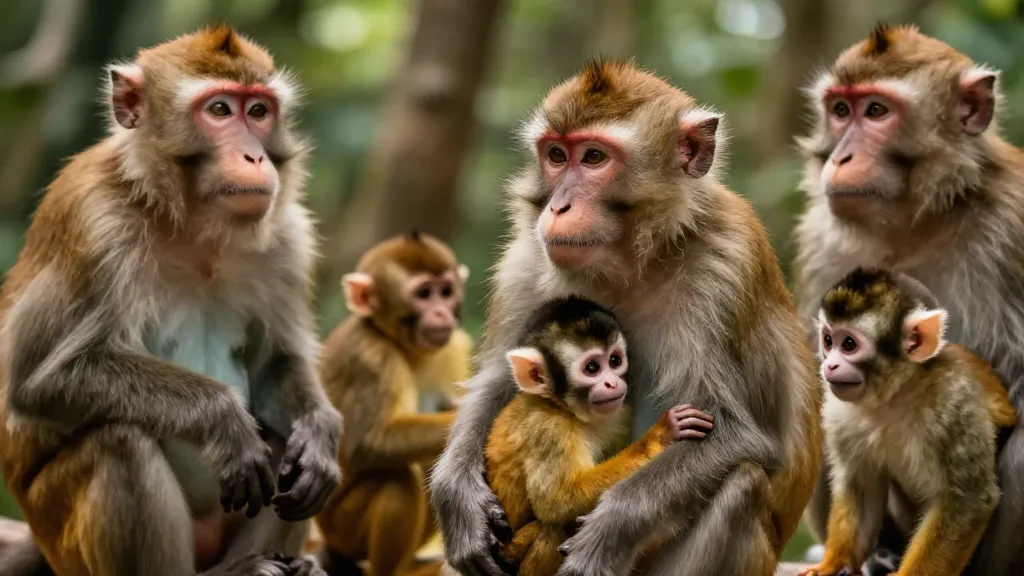
Among the species facing comparable or tighter constraints are macaques and squirrel monkeys—primates that, while sharing our evolutionary branch, have taken different developmental paths. These findings suggest that difficult childbirth isn’t a unique tax on human intelligence or bipedalism, but rather a recurring challenge that evolution has imposed on several primate lineages for different reasons.
This reframing matters. For decades, the difficulty of human childbirth has been cited as evidence of our unique evolutionary trajectory: our big brains demand big heads, our upright posture narrows the pelvis, and nature’s solution is to birth babies relatively underdeveloped compared to other primates. All true. But it’s not the whole truth.
What This Reveals About Evolution
The broader implication is that cephalopelvic constraint is a shared primate problem, not a human problem. Different species have arrived at similar biological predicaments through different evolutionary routes. Some may have enlarged offspring, others may have constraints imposed by skeletal anatomy unrelated to brain size. The specific cause matters less than the pattern: evolution often paints itself into corners, and reproduction is one of the tightest corners of all.
What to Watch For
- Further research on causation: Why do these specific species face tight fits? Is it brain size, body proportions, or something else entirely?
- Comparative maternal mortality data: Do species with tighter fits experience higher rates of birth complications?
- Evolutionary trade-offs: What advantages might offset the costs of difficult childbirth in these species?
- New primate species analysis: As more species are studied, the pattern may become even clearer—or more complicated.
Why This Matters Beyond Academia
This finding is a useful corrective to a common rhetorical move: the appeal to human uniqueness. We’re fascinated by what makes us special, and evolution has given us plenty of genuinely distinctive traits. But childbirth difficulty isn’t one of them. Recognizing that other primates face comparable biological constraints doesn’t diminish human complexity—it actually deepens our understanding of how evolution works.
It’s a reminder that nature doesn’t care about our sense of uniqueness. It solves problems the same way across species, sometimes creating similar bottlenecks in the process. And sometimes, the most interesting scientific discoveries aren’t about how special we are, but about how much we share with the rest of the animal kingdom.