
Science in 2050: Nuclear Fusion, Mars Missions, and AI Scientists—What's Actually Realistic?
Nature's bold forecast for 2050 reveals a world transformed by fusion energy, superintelligent AI doing research, and humans on Mars—but experts warn some dreams may be oversold while climate reality bites harder than expected.
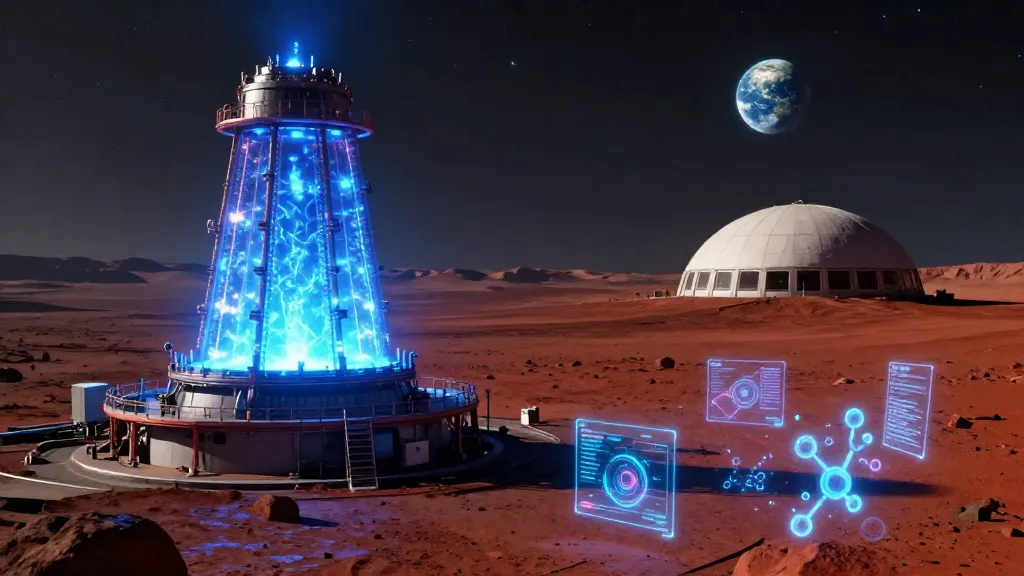
We tend to imagine the future as a grand technological spectacle—fusion reactors humming peacefully, humans planting flags on Mars, AI scientists churning out Nobel Prize–worthy discoveries while we sip coffee and watch. But the real 2050 may look far messier, stranger, and more constrained than the optimistic headlines suggest. Nature’s latest forecast reveals not just what might break through, but what could break down—and the gap between those two possibilities is where the actual future lives.
The Climate Elephant in the Room
Before we get excited about Mars missions and fusion reactors, there’s an uncomfortable truth: the world will likely have already sailed past the 2°C warming threshold by 2040, according to climate modelers. By 2050, we’re looking at a planet that’s warmed significantly beyond what most international agreements hoped to prevent.
Guy Brasseur, a climate modeler at the Max Planck Institute for Meteorology, puts it bluntly: “It will be worse than we had anticipated in terms of climate change.” The Paris Agreement’s targets required global emissions to peak in 2025 and then decline sharply—a deadline that’s already slipped past. The inertia built into Earth’s climate system means even if we stopped all emissions tomorrow, warming would continue for decades.
The Geoengineering Gamble
Here’s where things get genuinely risky. As climate impacts worsen, desperate nations or even wealthy companies might unilaterally attempt geoengineering—injecting reflective particles into the upper atmosphere to bounce sunlight away from Earth’s surface. It’s never been tested at significant scale. It’s unproven. And it could backfire spectacularly.
“You could have some countries that are using it unilaterally,” Brasseur warns, “just thinking that it will solve their problem without looking at the consequence for others.” Rainfall patterns could shift. Weather systems could destabilize further. The cure could become the disease.
The Carbon Removal Wildcard
There’s one more optimistic thread: what if removing CO₂ from the air becomes so profitable that companies do it at scale? Elina Hiltunen, a futures researcher in Helsinki, suggests we might manufacture plastics, fuels, and medications directly from atmospheric carbon. It’s speculative, but it represents a scenario where market forces—rather than political will—drive climate solutions.
The AI Wildcard Nobody Wants to Talk About
Nick Bostrom, the Oxford philosopher who wrote Superintelligence, has a prediction that should make every researcher nervous: “There’s a good likelihood that by 2050, all scientific research will be done by superintelligent AI rather than human researchers. Some humans might do science as a hobby, but they wouldn’t be making any useful contributions.”
Whether that’s accurate or alarmist depends partly on how fast artificial general intelligence actually arrives—and experts disagree wildly on that timeline.
What to watch for:
- AI systems capable of autonomous “lights out labs” running experiments 24/7 without human intervention
- Machine-learning systems potentially producing Nobel Prize–worthy discoveries
- The acceleration of quantum sensors enabling detection of gravitational waves and primordial black holes
- Robotics combined with AI reshaping how biotechnology research happens
- The moment when prediction becomes science fiction (spoiler: it’s closer than you think)
Alex Ayad, co-founder of the London foresight company Outsmart Insight, is honest about the uncertainty: “I could give you a relatively good view of what AI will look like in 2027, 2028. But I don’t know if I can be confident about where we’d be in 2030.” Beyond that, visibility drops off a cliff.
Nuclear Fusion: Finally Growing Up?
For decades, fusion has been the perpetual promise—always 30 years away, always just beyond reach. But something shifted recently. Juan Carlos Hidalgo, a physicist at Mexico’s National Autonomous University, offers cautious optimism: “Nuclear fusion has progressed more in the last 5 years than it has in the previous 50.”
By 2050, fusion might finally mature into a practical, scalable energy source. That’s not guaranteed, but the trajectory looks genuinely different from the hype cycle of the past. The catch? It still needs sustained investment and political support—both increasingly uncertain.
Mars: The Engineering Fantasy vs. Biological Reality
Everyone wants to talk about Mars. Donald Trump has restated NASA’s goal of getting humans there well before 2050. Elon Musk claims SpaceX could send an uncrewed starship by 2026, with crewed missions in the 2030s.
But Emilia Javorsky, director of the Futures Program at the Future of Life Institute, raises a crucial problem: “This is a field that’s driven predominantly by engineers, aerospace engineers, mechanical engineers that greatly underestimate the biological challenges.”
Space radiation exposure during the multi-month journey. Muscle and bone loss from prolonged microgravity. Psychological strain from isolation. These aren’t engineering problems with engineering solutions—they’re biological constraints that no clever hack will simply wish away. Getting to Mars by 2050 is technically possible. Getting humans there safely is a different question entirely.
Dark Matter, Quantum Sensors, and Cosmology’s Next Act
Meanwhile, quieter revolutions might be underway. Advances in quantum sensing—detecting minute changes in magnetic and electrical fields from individual electrons and nuclear spins—could be incorporated into gravitational wave detectors. That would let cosmologists spot smaller objects than currently possible, potentially including primordial black holes formed just after the Big Bang.
Those objects might hold the missing mass currently unaccounted for in the Universe. Finding them could finally crack open the mysteries of dark matter and dark energy, producing a successor to the standard model of cosmology—which is already showing cracks under the weight of recent observational data.
It’s unglamorous compared to Mars, but it might be the most transformative science of the next 25 years.
The Invisible Threat: Loss of Public Support
Here’s what nobody wants to admit: all of these breakthroughs depend on something that’s increasingly fragile—sustained public and political support for science itself.
The rise of populism, the appeal of quick fixes to complex problems, and political attacks on the value of research create a hostile environment for the kind of patient, long-term work that builds the foundation for breakthrough discoveries. Patrick van der Duin, a foresight consultant, warns: “The continued squeeze on public spending in sluggish economies, combined with political attacks on the value of science, could mean that researchers find themselves under increasing pressure to justify the expense of their work. That’s not very good for the future of science.”
When governments delete climate science from official websites, when research budgets shrink, when politicians promise quick solutions to problems that require decades of work—that’s when the future starts to look less like breakthrough and more like breakdown.
The Prediction Paradox
Richard Watson, a futurist and co-author of The Children’s Book of the Future, offers honest counsel: predictions under five years are just gravitational pulls of the present. Go beyond 20 years and “it gets very sci-fi very quickly.” The 2050 horizon—25 years out—sits in that awkward sweet spot where it’s far enough to imagine real change, but close enough that we can still be held accountable for getting it wrong.
The future will almost certainly include technological leaps we haven’t imagined. It will also include constraints and conflicts we’re underestimating. The real 2050 won’t be a simple story of fusion triumph or AI takeover or Martian colonies. It’ll be messier than that—a world where fusion finally delivers, but climate denial delays its deployment; where AI reshapes science, but geopolitical fragmentation limits its benefits; where we reach Mars, but discover that biology is harder to hack than we thought.
That’s not a failure of vision. That’s just what the future actually looks like.