
Baby Chicks Can Match Sounds to Shapes Just Like Humans—And It Changes Everything We Know About Brains
A groundbreaking study reveals baby chickens exhibit the same sound-shape connections as humans, suggesting this cognitive ability is hardwired into brains long before language develops. This discovery could revolutionize our understanding of how minds process information.
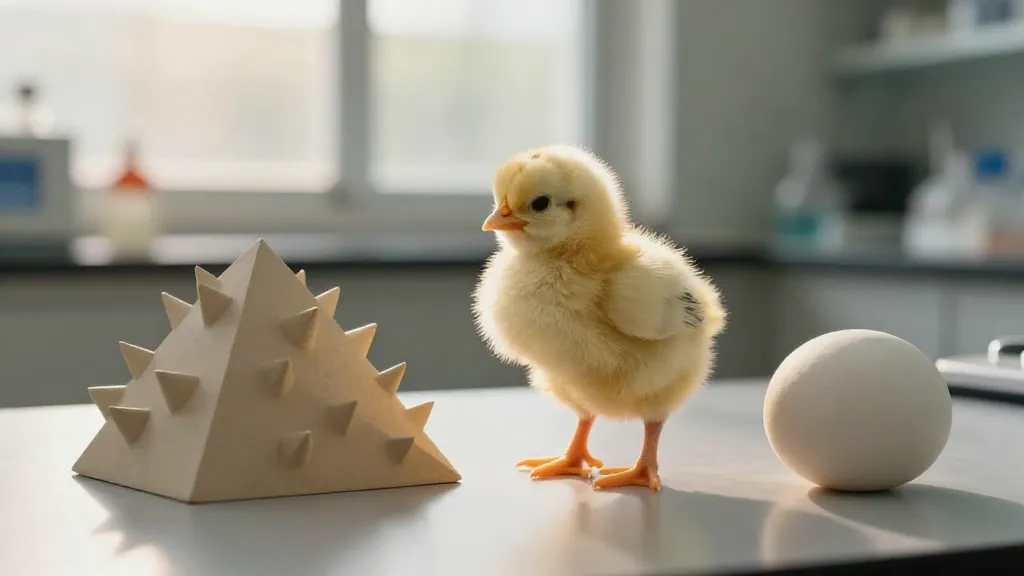
Something extraordinary has been hiding in plain sight in the most unexpected place—a chicken coop. Researchers have discovered that baby chicks, just days old, can match sounds to shapes in exactly the same way humans do. This isn’t just a cute animal trick; it’s a finding that could fundamentally change how we understand the wiring of brains across species.
The Bouba-Kiki Effect Goes Feathered
The discovery centers around something called the “bouba-kiki effect,” a fascinating quirk of human cognition that researchers have studied for decades. When humans hear the made-up word “bouba,” they typically associate it with round, curved shapes. The word “kiki,” on the other hand, gets linked to sharp, angular forms. This isn’t learned behavior—it happens across cultures and languages, suggesting something deeper at work in our minds.
Now, according to recent research reported by NPR, baby chickens demonstrate this exact same cognitive pattern. The chicks, tested when they were just days old, showed the same sound-shape associations that humans exhibit naturally.
What This Means for Brain Science
This discovery carries profound implications that extend far beyond the barnyard. If baby chicks—creatures with vastly different evolutionary histories from humans—share this cognitive ability, it suggests that sound-shape associations might be a fundamental feature of how brains process information.
A Window Into Language Development
The bouba-kiki effect has long been linked to human language emergence. Researchers theorized it might represent an early building block in how we develop the ability to connect sounds with meanings. Finding this same pattern in chicks raises intriguing questions about whether this cognitive mechanism predates language entirely.
Hardwired, Not Learned
Perhaps most remarkably, the chicks displayed this ability when they were barely out of their shells. This timing suggests the sound-shape connection isn’t something learned through experience or cultural transmission—it appears to be hardwired into the brain itself.
What Scientists Are Watching For
As this research develops, experts are likely monitoring several key areas:
• Whether other animal species demonstrate similar sound-shape associations
• How early in development this ability emerges across different creatures
• What specific brain mechanisms might underlie this cross-modal processing
• How this finding might inform theories about language evolution
The Bigger Picture
This research represents more than just an interesting parallel between humans and chickens. It opens up entirely new questions about the fundamental architecture of cognition itself. If such specific cognitive patterns appear across vastly different species, what other “universal” features of information processing might exist in brains throughout the animal kingdom?
The study also highlights how much we still don’t understand about the minds of creatures we often dismiss as simple. These baby chicks, with their tiny brains, are demonstrating sophisticated cognitive abilities that mirror our own most complex mental processes.
Rethinking What Makes Minds Tick
While researchers continue to investigate the full implications of this discovery, one thing seems clear: the boundaries between human and animal cognition may be far blurrier than we previously imagined. The fact that a baby chick can perform the same sound-shape matching that humans do suggests we’re tapping into something truly fundamental about how brains—regardless of species—make sense of the world around them.
This finding doesn’t just change what we know about chickens. It changes what we know about minds.