
Bonobo Shocks Scientists by Tracking Imaginary Objects—A Trait We Thought Only Humans Had
A groundbreaking study reveals that bonobos can track imaginary objects in controlled experiments, challenging the long-held belief that imagination is uniquely human. This discovery suggests our closest primate relatives share cognitive abilities we never knew existed.
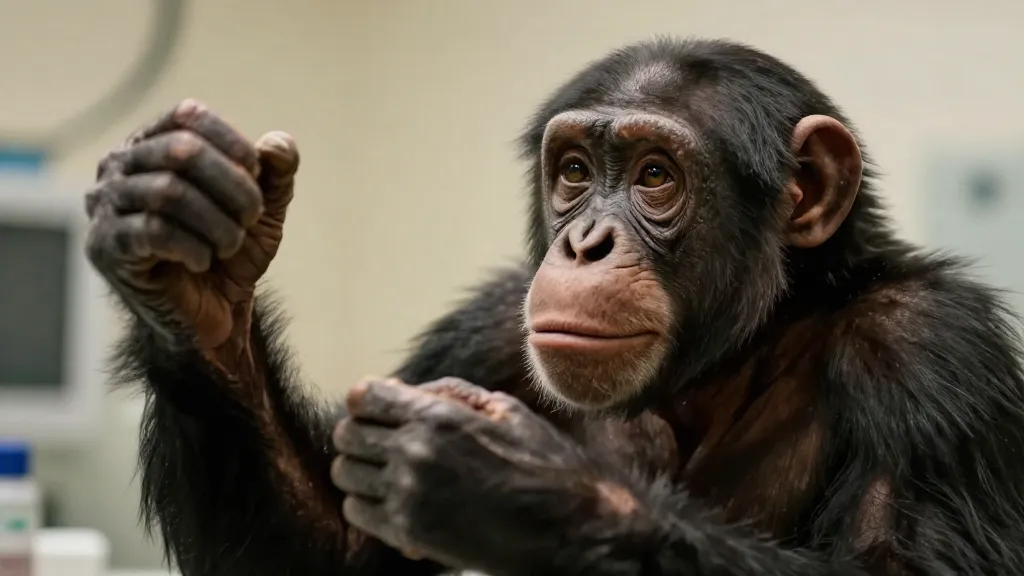
Picture this: you’re having a tea party with an invisible friend, carefully pouring pretend tea into an empty cup and passing imaginary cookies around the table. For decades, scientists believed this kind of imaginative play was what separated us from every other species on Earth. But a bonobo just shattered that assumption in the most delightful way possible.
In a groundbreaking study that reads like something out of a children’s book, researchers discovered that our closest primate relatives can track and interact with objects that exist only in their minds. This isn’t just cute animal behavior—it’s a cognitive earthquake that’s forcing scientists to completely rethink what makes humans special.
The Tea Party That Changed Everything
The experiments that led to this discovery were surprisingly whimsical for serious science. Researchers designed controlled tests modeled on children’s tea parties, creating scenarios where bonobos had to track and respond to imaginary objects in structured settings.
Reports suggest the bonobo in question successfully demonstrated the ability to maintain awareness of these invisible items throughout the experimental sessions. The methodology appears to have been carefully designed to eliminate other explanations for the behavior, though specific details about the peer-review process and full experimental parameters remain to be clarified.
Why This Discovery Matters
For generations, imagination has been held up as the crown jewel of human cognition—the thing that allowed us to create art, tell stories, and build civilizations. Scientists have long argued that our ability to think about things that don’t exist is what fundamentally distinguishes us from other animals.
This bonobo’s performance suggests that assumption may have been wrong all along. If our closest evolutionary relatives can engage with imaginary concepts, it hints that the roots of imagination stretch much deeper into our shared evolutionary past than anyone realized.
What Scientists Are Watching For
As this research develops, observers note several key areas that warrant attention:
• Replication of results with other bonobos and primate species • Peer review and validation of the experimental methodology • Clarification of what “imagination” means in this specific context • Investigation into whether this ability exists in wild bonobo populations
The Bigger Picture
This discovery arrives at a time when scientists are increasingly questioning human exceptionalism—the idea that humans possess completely unique cognitive abilities that set us apart from all other life forms. From tool use to self-awareness to complex communication, trait after trait once considered uniquely human has been found in other species.
The bonobo’s apparent ability to track imaginary objects adds another item to this growing list, suggesting that the line between human and animal cognition may be far blurrier than we ever imagined.
What This Means for Our Understanding of Evolution
If bonobos can indeed engage with imaginary concepts, it raises fascinating questions about when and why this ability evolved. Did our common ancestor with bonobos already possess some form of imagination? Or did this capacity develop independently in both species?
The implications extend beyond academic curiosity. Understanding the evolutionary origins of imagination could shed light on everything from the development of human creativity to potential therapeutic approaches for cognitive disorders.
The Road Ahead
While this initial finding is remarkable, scientists emphasize that much work remains to be done. The research needs to be replicated, peer-reviewed, and expanded to include more subjects and varied experimental conditions.
What’s clear is that this bonobo has already accomplished something extraordinary: it’s forced us to reconsider one of the most fundamental assumptions about what makes us human. In a world where we often see ourselves as separate from and superior to other species, discoveries like this remind us that we’re part of a much richer, more connected web of consciousness than we ever dared to imagine.
The next time you watch a child playing with invisible friends, remember that somewhere out there, a bonobo might be doing something remarkably similar—and that’s not diminishing to human specialness, but rather a beautiful reminder of the deep evolutionary bonds we share with our fellow primates.