
Bumblebees Just Solved a Puzzle They'd Never Seen Before—Scientists Are Stunned
Finnish researchers discovered that bumblebees can spontaneously solve complex problems without prior training, revealing unexpected cognitive abilities that challenge our understanding of insect intelligence.
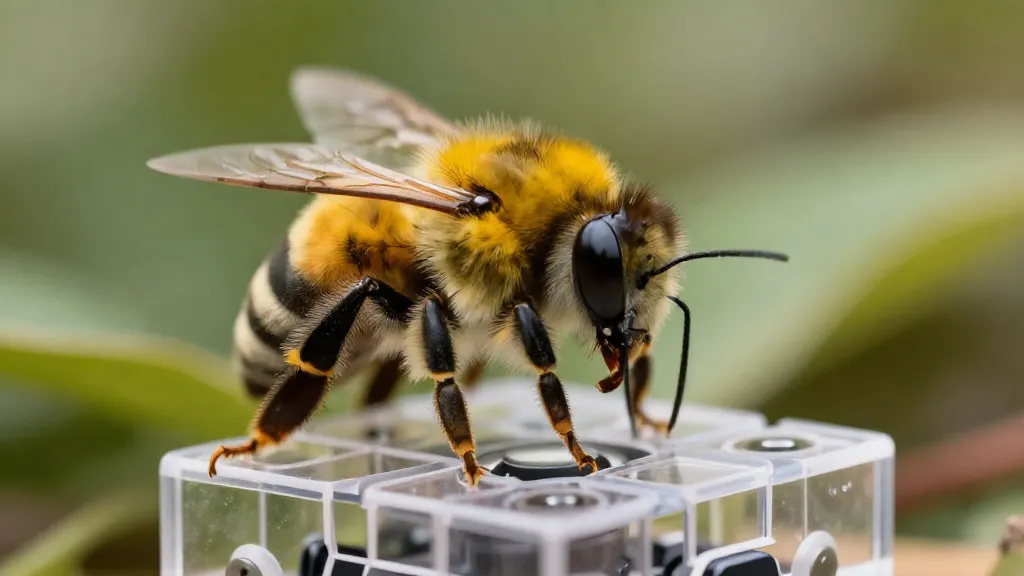
A buzzing bumblebee hovers over a peculiar contraption—a transparent box with a sweet reward trapped inside and a string dangling tantalizingly nearby. Without any training or prior experience, the bee grasps the string with its tiny legs and pulls, successfully retrieving the prize. This remarkable scene, captured in Finnish laboratories, is rewriting what scientists thought they knew about insect intelligence.
The Unexpected Problem-Solving Champions
Finnish researchers have discovered that bumblebees possess an extraordinary ability to spontaneously solve complex problems they’ve never encountered before. The study reveals that these fuzzy pollinators can tackle what scientists call an insect version of the classic “box-and-banana” problem—a cognitive test typically used to assess intelligence in primates and other higher animals.
The findings challenge long-held assumptions about the limitations of insect cognition. While bees have long been recognized for their impressive navigation skills and sophisticated communication through waggle dances, this new research suggests their mental capabilities extend far beyond what scientists previously imagined.
Breaking Down the Bee Brain Puzzle
The experimental setup was elegantly simple yet cognitively demanding. Researchers presented bumblebees with a transparent container holding a sugary reward, accessible only by pulling a string attached to a movable platform. The bees had never seen this type of puzzle before, yet many managed to solve it on their first attempt.
What makes this discovery particularly stunning is the spontaneous nature of the problem-solving. Unlike previous studies that required extensive training or conditioning, these bees demonstrated what researchers call “insight learning”—the ability to understand a problem and devise a solution through reasoning rather than trial and error.
Key Behaviors Observed:
- Bees grasped strings with their legs to pull rewards closer
- Multiple individuals solved the puzzle without prior training
- Problem-solving occurred within minutes of first exposure
- Success rates varied among individual bees
Rethinking Insect Intelligence
This breakthrough forces scientists to reconsider fundamental questions about consciousness and cognitive ability across the animal kingdom. The research suggests that complex problem-solving skills may be more widespread in nature than previously thought, existing even in creatures with brains containing fewer than one million neurons.
The implications extend beyond basic science. Understanding how such small brains can accomplish sophisticated cognitive tasks could inspire new approaches in artificial intelligence and robotics, where efficiency and miniaturization are constant challenges.
What This Means for Future Research
The Finnish study opens new avenues for investigating insect cognition and raises intriguing questions about the evolution of intelligence. If bumblebees can spontaneously solve novel problems, what other cognitive abilities might be hiding in the insect world?
Researchers note that these findings represent just the beginning of a deeper exploration into bee intelligence. Future studies may reveal even more surprising cognitive capabilities, potentially reshaping our understanding of how intelligence emerges and functions across different species.
The humble bumblebee, once viewed primarily as a simple pollinator driven by instinct, now stands as a testament to the remarkable complexity that can emerge from nature’s smallest packages. As scientists continue to probe the mysteries of insect cognition, one thing becomes clear: intelligence comes in far more forms than we ever imagined.