
Earth's Core Is Growing One Millimeter Every Year—Here's What That Means
Scientists have discovered that Earth's solid iron core expands roughly one millimeter annually as our planet gradually cools over geological time. This expansion rate is helping researchers unlock clues about how old Earth really is.
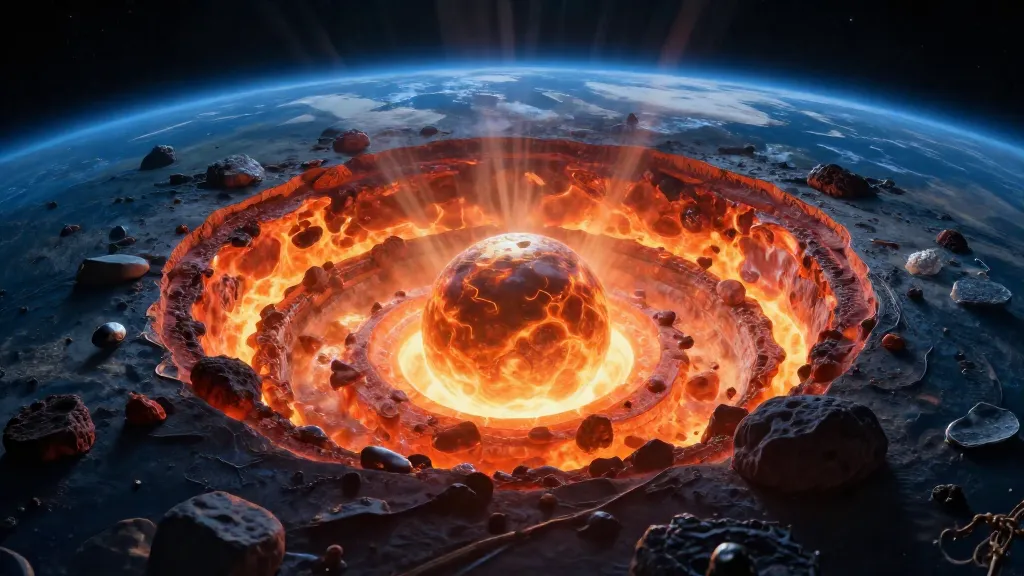
Deep beneath your feet, in a place no human has ever been or ever will, Earth’s solid iron core is quietly growing. Every single year, it expands by roughly one millimeter—a cosmic clock ticking away the planet’s age, one microscopic layer at a time. This isn’t science fiction. It’s happening right now, and it’s fundamentally changing how we understand our world.
A Solid Core, Not a Molten Furnace
Most people imagine Earth’s center as a raging ball of molten rock, a churning inferno that powers volcanic eruptions and earthquakes. That’s wrong. Beneath the liquid iron outer core lies something far more surprising: a solid sphere of iron-rich metal, smaller than the Moon yet probably more massive. It’s a world within our world, and for decades, scientists only understood it dimly.
This inner core isn’t a cavern. It isn’t a furnace. It’s a dense, metallic ball that has puzzled geologists and physicists for generations. But recent research has revealed something remarkable about how it works—and what it can tell us.
The Cosmic Clock: How Cooling Creates Growth
Here’s where it gets interesting. As Earth gradually loses heat over geological time—a process unfolding across millions and billions of years—the liquid metal surrounding the inner core begins to freeze. This freezing doesn’t happen all at once. Instead, it occurs in layers, crystallizing onto the surface of the solid iron sphere year after year, century after century.
The result? The inner core expands. Roughly one millimeter per year.
One millimeter might sound insignificant. Over a human lifetime, it’s invisible. But over geological timescales, it becomes a measurable, trackable phenomenon. Scientists can study this expansion rate to understand how much heat Earth has lost, and from that, they can calculate how old our planet really is.
Why This Matters for Understanding Earth’s Age
The expansion of Earth’s core serves as a natural timer for our planet. By measuring how much the core has grown and at what rate, researchers gain insight into:
- How much thermal energy Earth has shed since its formation
- The rate at which our planet has cooled over billions of years
- Constraints on Earth’s true age and thermal history
- How planetary cooling affects the entire structure of our world
This isn’t abstract theory. It’s a physical process with measurable consequences, and it helps validate other methods scientists use to date our planet.
What to Watch For
As research continues, keep an eye on:
- New measurements of core expansion rates from seismic data and other monitoring techniques
- Refined estimates of Earth’s age based on core cooling models
- How this discovery connects to our understanding of the planet’s magnetic field (powered by the liquid outer core)
- Further insights into how long Earth’s interior will remain geologically active
The Bigger Picture
Earth’s expanding core is a humbling reminder that our planet is constantly changing, even in ways we can barely perceive. The ground beneath us feels solid and permanent, yet deep down, fundamental transformations are occurring at scales and timescales almost impossible for humans to grasp.
This slow, steady growth represents one of the most patient processes in nature—a planetary metamorphosis playing out across eons. And now, for the first time, we have the tools to measure it, understand it, and use it to read the story of our world’s past.
The next time you think about Earth’s age, don’t imagine dusty textbooks or abstract numbers. Picture that iron sphere a thousand miles beneath your feet, growing imperceptibly, grain by grain, year by year. That’s the real story of our planet’s history, written in metal and heat, one millimeter at a time.