
Jellyfish Sleep Like Humans—Without a Brain. Here's Why That Matters
Researchers discovered that brainless jellyfish and sea anemones sleep 8 hours daily in patterns nearly identical to humans, suggesting sleep evolved to repair DNA in nerve cells rather than requiring a centralized brain.
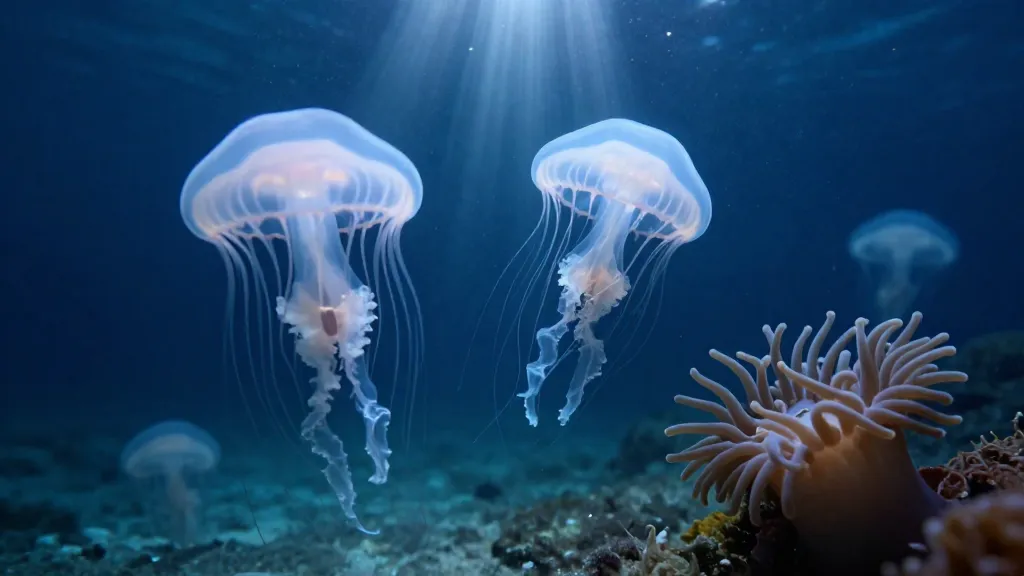
You’ve probably never thought about jellyfish needing a nap. But according to a groundbreaking study published in Nature Communications, these ancient sea creatures—which don’t even have brains—sleep roughly eight hours a day in patterns nearly identical to humans. And this discovery is forcing scientists to completely rethink what sleep actually is and why it evolved in the first place.
The Brainless Sleepers
For decades, researchers assumed sleep required a centralized nervous system to coordinate the process. It made intuitive sense: we think of sleep as something our brain controls, a state of consciousness we drift into and out of. But jellyfish and sea anemones shatter that assumption entirely.
A team led by molecular neuroscientist Lior Appelbaum at Bar-Ilan University studied two creatures: the upside-down jellyfish (Cassiopea andromeda) and the starlet sea anemone (Nematostella vectensis). Both have neurons—the building blocks of nervous systems—but lack the centralized brain that we’ve long considered essential for sleep.
What they found was striking. The upside-down jellyfish sleeps about eight hours daily, mostly at night with an occasional midday nap. The sea anemone sleeps roughly one-third of each day, with rest concentrated around dawn. These patterns mirror human sleep architecture far more closely than anyone expected.
Why This Changes Everything
“Neurons are very precious,” Appelbaum explains. “They don’t divide, so you need to keep them intact.” That single observation hints at something profound: sleep may have evolved not for consciousness or memory consolidation, but for cellular maintenance at the most fundamental level.
This theory gains momentum when you consider what sleep actually costs these creatures. Sleep is risky. It leaves animals vulnerable to predators, prevents them from hunting or mating, and cuts into time spent caring for offspring. Evolution doesn’t preserve risky behaviors unless they serve a critical function. The fact that sleep persists across virtually all animals with nervous systems—including ones that lack brains entirely—suggests it solves a problem so essential that no creature can afford to skip it.
DNA Repair as Sleep’s Original Purpose
The leading hypothesis, bolstered by this research, centers on DNA repair. While animals are awake, their neurons accumulate damage from metabolic stress and environmental factors. Sleep provides a window for cells to repair that damage before it becomes catastrophic.
“There is good evidence that sleep emerged with neurons,” says Ravi Nath, a postdoctoral neuroscientist at Stanford University who conducted earlier work demonstrating sleep-like states in jellyfish. “There is likely a core function, but each species has also adapted sleep to meet its own needs.”
This reframes sleep’s entire evolutionary story. Rather than being a luxury that complex brains invented, sleep appears to be a fundamental cellular maintenance process that predates the evolution of centralized nervous systems. Brains later adapted and modified this ancient mechanism to serve additional purposes—memory consolidation, emotional regulation, and more—but the core function remained consistent.
What to Watch For
- New species discoveries: Each time researchers identify sleep in a previously unstudied creature, it strengthens the theory that sleep is universal among animals with neurons
- Molecular mechanisms: Future studies will likely zoom in on exactly which DNA repair processes happen during sleep in these simple organisms
- Evolutionary timeline: Understanding when and why sleep first emerged could reshape our knowledge of early animal evolution
- Human implications: Insights from brainless creatures might reveal sleep functions we’ve overlooked in ourselves
The Implications for Human Sleep
If sleep’s original function was cellular maintenance and DNA repair, what does that mean for us? It suggests that the eight-hour recommendation isn’t arbitrary—it may reflect a biological need that’s been encoded in our cells for hundreds of millions of years. When we shortchange our sleep, we’re not just affecting our mood or alertness; we’re potentially compromising the cellular repair processes that keep our neurons healthy.
It also challenges the notion that sleep is somehow a “waste” of time or a luxury we can cut back on when life gets busy. From the perspective of these ancient sea creatures, sleep isn’t a feature that sophisticated brains invented. It’s a requirement that even the simplest nervous systems demand.
The Bigger Picture
Chiara Cirelli, a sleep researcher at the University of Wisconsin–Madison, emphasizes the significance of this work: “Every time somebody adds to the list of species that sleep, it is a very important step for the field.” Each new discovery narrows down what sleep actually is at its core, stripping away the bells and whistles that different species have added and revealing the essential function that unites all nervous systems.
A jellyfish drifting in the ocean, taking its midday nap without consciousness or dreams, is performing the same cellular maintenance ritual that you perform every night. That’s not just fascinating—it’s a reminder that some of life’s most fundamental processes operate at a level far deeper than thought or awareness. And sometimes, the simplest creatures teach us the most profound truths about ourselves.