
Scientists Discover Deer Leave Invisible Glowing Trails That Only They Can See
New research reveals deer can see and produce ultraviolet light, creating secret communication trails invisible to humans but visible to other deer and their predators. This groundbreaking discovery changes how we understand forest wildlife interactions.
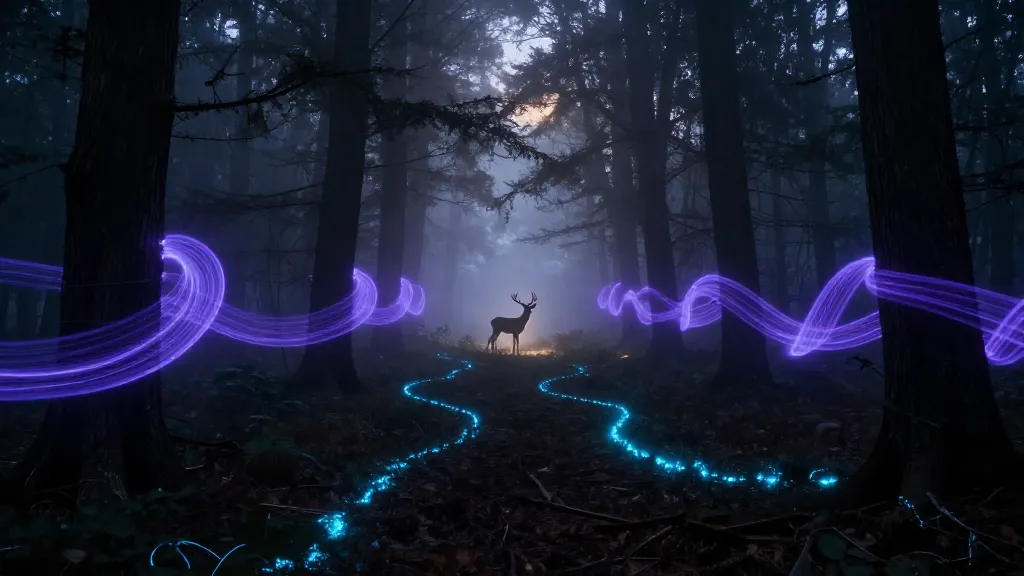
The forest around you is alive with invisible messages, glowing trails crisscrossing through the underbrush like a secret highway system. While you walk through what appears to be an ordinary woodland, deer are navigating an entirely different world—one painted in ultraviolet light that your eyes simply cannot detect.
Recent scientific research has uncovered something extraordinary: deer don’t just see ultraviolet light, they actively create glowing trails that remain invisible to human eyes but shine like beacons to other deer and their predators. This discovery is revolutionizing our understanding of how forest animals communicate and survive in their environment.
The Hidden UV World of Deer
For years, scientists have known that many animals can perceive ultraviolet wavelengths that humans cannot see. What researchers didn’t expect was to discover that deer are not just passive observers of this UV landscape—they’re active participants, leaving behind luminous traces as they move through their territory.
The ability to both see and produce ultraviolet signals creates an entirely parallel communication network in forests worldwide. While humans experience the woods through visible light, sounds, and scents, deer operate in an additional sensory dimension that has remained hidden from us until now.
How the UV Trail System Works
The mechanism behind these glowing trails appears to be linked to natural compounds that deer deposit as they move through their environment. These substances become visible under ultraviolet light, creating a network of pathways that other deer can follow and interpret.
Reports suggest this UV signaling system may serve multiple purposes in deer behavior and survival:
- Territory marking - Establishing boundaries invisible to most other species
- Predator detection - Warning signals that alert other deer to danger
- Navigation assistance - Creating familiar routes through dense forest areas
- Social communication - Conveying information about food sources or safe passages
The Predator Advantage
Perhaps the most intriguing aspect of this discovery is that deer aren’t the only animals who can see these ultraviolet trails. Many of their natural predators also possess UV vision, which means they can potentially track deer using the very signals deer use to communicate with each other.
This creates a fascinating evolutionary tension. The same UV trails that help deer navigate and communicate with their own species may also make them more visible to the wolves, mountain lions, and other predators that hunt them.
Implications for Wildlife Research
This breakthrough opens up entirely new avenues for understanding forest ecosystems. If deer are creating invisible communication networks, researchers now wonder what other animals might be operating in similar UV dimensions that we’ve completely overlooked.
The discovery also raises questions about how human activity in forests might be disrupting these invisible animal highways. Light pollution, habitat fragmentation, and other environmental changes could be interfering with communication systems we never knew existed.
What Scientists Are Watching For
As research continues, scientists are particularly interested in several key areas:
• Whether other ungulate species exhibit similar UV trail behavior • How seasonal changes affect the visibility and persistence of UV signals • The specific chemical compounds responsible for creating these glowing trails • How predators might be adapting their hunting strategies around UV detection
A New Perspective on Nature
This research reminds us how much we still don’t know about the natural world around us. Every forest walk now carries the knowledge that we’re moving through an invisible landscape of animal communication—a glowing network of messages and pathways that has existed all along, just beyond our perception.
The next time you’re hiking through the woods, imagine the ultraviolet highways crisscrossing your path. Somewhere in wavelengths you cannot see, deer are leaving their luminous calling cards, navigating a secret world that’s been hiding in plain sight all along.
As technology advances and our understanding deepens, who knows what other invisible animal communication systems we might discover? The forest, it turns out, is far more complex and interconnected than we ever imagined.