
Scientists Discover How Bacteria Squeeze Through Impossibly Tight Spaces Using Ingenious Body-Wrapping Technique
Researchers have revealed the remarkable way bacteria navigate microscopic passages barely larger than themselves by wrapping their flagella around their bodies. This breakthrough discovery could revolutionize our understanding of bacterial movement in confined spaces.
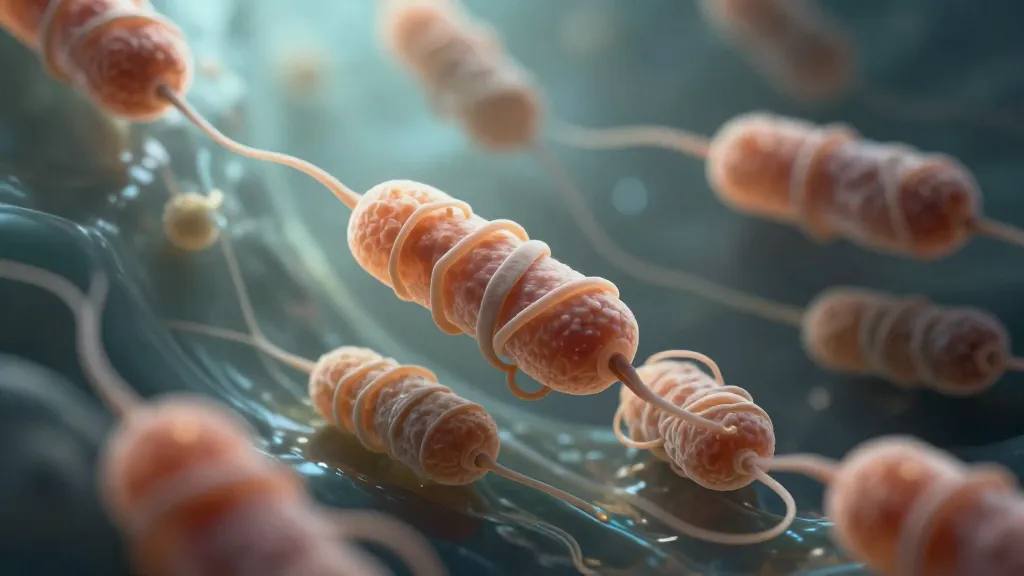
Scientists have uncovered one of nature’s most ingenious engineering solutions hiding in plain sight at the microscopic level. Researchers studying bacterial movement have discovered that these tiny organisms possess a remarkable ability to squeeze through spaces barely larger than their own bodies—and they do it by essentially giving themselves a full-body hug with their whip-like appendages.
The Microscopic Squeeze Play
The breakthrough came when researchers used specialized microfluidic devices designed to mimic the narrow channels found in insect guts. These artificial passages presented bacteria with the ultimate spatial challenge: how to navigate through spaces that seem impossibly tight for their cellular bodies.
What the scientists observed was nothing short of remarkable. Instead of being stopped by these constraints, bacteria demonstrated an elegant solution that combines physics and biology in unexpected ways.
Flagella: More Than Just Propellers
Most people familiar with bacteria know about flagella—the thread-like structures that bacteria use like tiny propellers to swim through liquid environments. But this research reveals that flagella serve a dual purpose that scientists hadn’t fully appreciated before.
When faced with extremely narrow passages, bacteria don’t just use their flagella for propulsion. They wrap these flexible appendages around their entire bodies, creating a streamlined package that can tunnel through spaces that would otherwise be impassable.
The Wrapping Technique
The process works like a microscopic version of tucking in loose clothing before squeezing through a tight space. By coiling their flagella around themselves, bacteria reduce their effective width and create a more compact form factor. This wrapped configuration allows them to push forward through channels that would block them in their normal swimming posture.
Why This Discovery Matters
This finding challenges our understanding of how bacteria navigate confined environments in the real world. The implications extend far beyond laboratory curiosity:
- Medical applications: Understanding bacterial movement through tight spaces could inform strategies for combating infections in narrow body passages
- Biotechnology: The mechanism might inspire new designs for microscopic robots or drug delivery systems
- Environmental science: It helps explain how bacteria spread through soil, rock crevices, and other constrained natural environments
- Food safety: The research sheds light on how bacteria might navigate through food processing equipment or packaging
A Window Into Microscopic Problem-Solving
The research demonstrates that even the simplest life forms possess sophisticated strategies for overcoming physical challenges. The fact that bacteria can dynamically reconfigure their body structure to solve spatial problems suggests a level of mechanical adaptability that researchers are only beginning to understand.
Looking Forward
While this discovery provides crucial insights into bacterial locomotion, questions remain about how widespread this behavior is among different bacterial species and what triggers the wrapping response. The research team’s use of microfluidic devices to recreate natural environments represents a promising approach for uncovering other hidden aspects of microbial behavior.
The study reminds us that nature’s solutions to engineering problems often surpass human ingenuity. In this case, bacteria have been using a technique that combines flexibility, spatial awareness, and mechanical efficiency—all at a scale invisible to the naked eye. As researchers continue to explore the microscopic world, discoveries like this one reveal that even the smallest organisms are capable of remarkably sophisticated behaviors.