
Starfish Navigate Without Brains—Scientists Just Discovered How They Do It
Scientists have finally cracked the mystery of how starfish climb walls and navigate complex terrain with hundreds of feet but no brain at all. The biological mechanisms they discovered are mind-blowing.
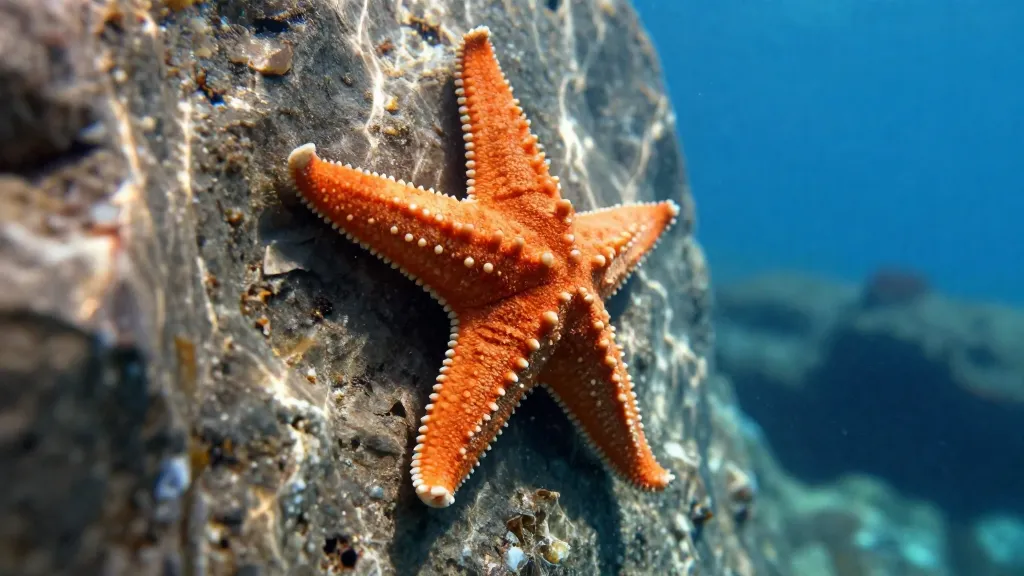
Picture a creature with hundreds of tiny feet effortlessly scaling a vertical glass wall, navigating rocky crevices, and even hanging upside down from cave ceilings. Now imagine this same creature has no brain whatsoever—not even a basic nervous system like we’d recognize. This isn’t science fiction; it’s the daily reality of the humble starfish, and scientists have finally cracked the code on how they pull off this biological impossibility.
The Ultimate Brainless Athletes
Starfish, also known as sea stars, are nature’s most accomplished climbers without central command. These remarkable invertebrates can traverse virtually any surface imaginable—whether it’s vertical rock faces, horizontal sandy bottoms, or even upside-down cave overhangs. No terrain seems too challenging: rocky, slimy, sandy, or glass surfaces all pose no problem for these marine acrobats.
What makes this feat truly extraordinary is that starfish accomplish all of this without a centralized nervous system, let alone anything resembling a brain. Each starfish arm is studded with rows of tube feet on its underside—hundreds of tiny appendages that somehow coordinate seamlessly despite having no central commander calling the shots.
The Mystery Finally Solved
A groundbreaking new study published in Nature by an international team of biologists and engineers has revealed the ingenious biological mechanisms that make starfish locomotion possible. The research shows that starfish movement is far more sophisticated than anyone previously imagined, with built-in adaptive features that allow these creatures to drastically modify their motion depending on the specific challenge they face.
Distributed Intelligence in Action
The key to starfish navigation lies in what scientists call distributed control—a system where intelligence emerges from the collective behavior of many simple parts rather than top-down commands from a central brain. Each tube foot operates somewhat independently, yet somehow they all work together to create coordinated movement.
This biological design allows starfish to:
- Adapt their grip strength based on surface texture
- Adjust their movement speed for different terrains
- Coordinate hundreds of feet without central planning
- Navigate complex three-dimensional environments
What This Means for Science
The implications of this discovery extend far beyond marine biology. Understanding how starfish achieve such remarkable coordination without centralized control could inspire new approaches in robotics, particularly for designing robots that need to navigate unpredictable terrain.
Engineering Applications
Researchers suggest that the starfish model could revolutionize how we design autonomous systems. Instead of relying on powerful central processors, future robots might use distributed intelligence similar to starfish—making them more adaptable and resilient when individual components fail.
The Bigger Picture
This research adds to our growing understanding of how complex behaviors can emerge from simple biological systems. Reports suggest that starfish represent just one example of how nature has solved the challenge of coordination without centralized control—a principle that appears throughout the natural world.
The study also highlights how much we still don’t know about seemingly familiar creatures. Starfish have been climbing walls and navigating complex terrain for millions of years, yet we’re only now beginning to understand the elegant biological engineering that makes it all possible.
While the specific molecular and cellular mechanisms behind this distributed control system require further investigation, this breakthrough opens new avenues for understanding both marine biology and the fundamental principles of coordination in living systems. Sometimes the most profound scientific discoveries come from taking a closer look at creatures we thought we already understood.