
Cosmic Rebel: The Interstellar Comet With a Backward Tail
Discover how 3I/ATLAS, our third interstellar visitor, breaks cosmic rules with its unusual tail pointing toward the Sun. This ancient cosmic traveler reveals unprecedented insights into star systems beyond our own.
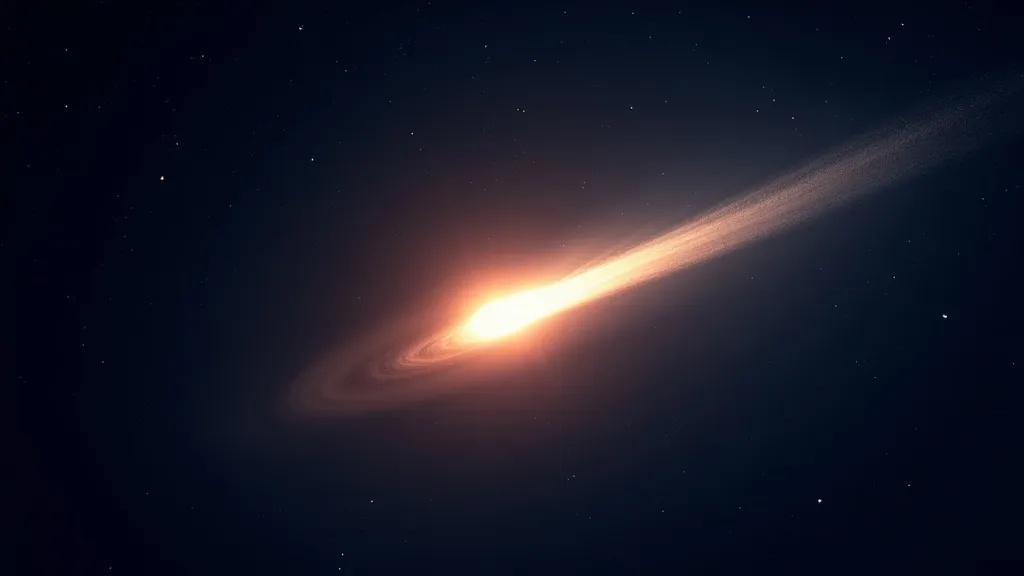
In the vast theater of space, some performers refuse to follow the script. Meet comet 3I/ATLAS—an interstellar visitor that’s breaking fundamental cosmic rules and challenging what astronomers thought they knew about these celestial wanderers.
An Unexpected Visitor From Beyond
In July 2025, astronomers detected something unusual racing through our cosmic neighborhood. This wasn’t just any comet—it was confirmed as only the third interstellar object ever detected passing through our solar system. Named 3I/ATLAS, this cosmic traveler formed around another star system before embarking on an epic journey that likely lasted up to 10 billion years before gracing us with its presence.
What makes this visitor truly special, however, goes beyond its distant origins. Recent observations using the powerful Keck Observatory have confirmed something that defies conventional astronomy: 3I/ATLAS possesses an “anti-solar tail” pointing toward the Sun rather than away from it.
Breaking the Rules of Cosmic Tails
If you’ve ever seen images of comets, you’ll recognize their characteristic tails streaming away from the Sun. This happens because solar radiation heats the comet’s surface, transforming ice directly into gas through sublimation. The process releases dust particles that get pushed backward by solar radiation pressure, creating that familiar tail pointing away from the Sun.
3I/ATLAS, however, didn’t get the memo.
Using spectroscopic analysis—essentially studying the “fingerprint” of light reflected off the comet—scientists discovered that large, heavy dust particles are being ejected from the comet’s sunlit side. Unlike typical cometary dust, these particles are too massive to be pushed back by solar radiation. Instead, they continue moving forward along the comet’s trajectory, creating the illusion of a tail pointing toward the Sun.
A Chemical Mystery From Another Solar System
The backward tail isn’t the only way 3I/ATLAS is challenging our understanding of the cosmos. Its chemical composition presents even deeper mysteries that could reshape our understanding of planetary formation throughout the galaxy.
Spectroscopic data revealed unusually high concentrations of nickel and cyanide in the comet’s coma—the cloud of gas and dust surrounding its nucleus. What’s particularly puzzling is the distribution of these elements:
- Nickel is concentrated within approximately 594 kilometers of the nucleus
- Cyanide extends further out, reaching about 841 kilometers
This chemical distribution doesn’t match what we typically observe in solar system comets. In fact, the production rate of nickel relative to cyanide is significantly higher than in our previous interstellar visitor, 2I/Borisov, and “orders of magnitude above” what we observe in comets that formed within our solar system.
A 10-Billion-Year-Old Time Capsule
Scientists theorize that these unusual metal concentrations might be attached to complex carbon molecules called PAHs (polycyclic aromatic hydrocarbons), forming nickel-PAH compounds. These compounds could be easily broken apart by sunlight, which would explain why the nickel appears so concentrated near the nucleus—it’s being released relatively quickly after exposure to solar radiation.
What makes these findings so valuable is that 3I/ATLAS essentially functions as a 10-billion-year-old time capsule, potentially preserving material from the earliest days of another solar system’s formation. By studying its composition and behavior, astronomers gain unprecedented insight into star systems we could never directly visit.
Natural Wonder, Not Alien Artifact
While some have speculated about artificial origins for interstellar objects (especially after the discovery of ‘Oumuamua, our first confirmed interstellar visitor), the evidence overwhelmingly supports 3I/ATLAS being a natural phenomenon. Its unusual features reflect the diversity of cometary formation processes throughout the galaxy rather than intelligent design.
That said, natural doesn’t mean ordinary. This comet is teaching us that the universe harbors far more diversity in its celestial objects than we previously imagined.
The Future of Interstellar Astronomy
As 3I/ATLAS continues its one-way journey through our solar system before returning to the interstellar void, astronomers are gathering as much data as possible from this rare visitor.
Meanwhile, technological advances promise more discoveries ahead. The upcoming Vera C. Rubin Telescope will significantly increase our ability to detect interstellar visitors, potentially revealing whether 3I/ATLAS’s unusual features are cosmic outliers or common characteristics of objects from beyond our solar neighborhood.
Conclusion: A Humbling Reminder
This interstellar visitor, with its backward-pointing tail and unusual chemistry, serves as a humbling reminder that the universe still holds countless surprises—even in objects that have been silently traveling through the cosmos since before our planet existed.
3I/ATLAS invites us to reconsider what we think we know about comets, interstellar objects, and perhaps even the fundamental processes of planetary formation throughout the galaxy. In breaking the rules, it opens new chapters in our understanding of the cosmos.
As we gaze upward at the night sky, it’s worth remembering that between the familiar stars and planets we’ve studied for millennia, there are wanderers from distant star systems quietly passing through, each with its own stories to tell—if only we know how to listen.