
Cosmic Time Capsule: 3I/ATLAS Reveals Another Star's Chemistry
Scientists have captured the chemical fingerprint of interstellar comet 3I/ATLAS, revealing surprising elements from another star system. This cosmic messenger's unusual nickel concentration and rare anti-solar tail challenge our understanding of chemistry across the galaxy.
Imagine holding a message in a bottle that’s traveled not across an ocean, but through the vast emptiness of interstellar space for perhaps 10 billion years. That’s exactly what astronomers have achieved by capturing the chemical fingerprint of 3I/ATLAS, a visitor from beyond our solar system carrying secrets locked in its ancient ice.
A Messenger From Another Star
In July 2025, the astronomical community buzzed with excitement when they discovered what would become the fastest interstellar object ever recorded racing through our solar system. Named 3I/ATLAS, this cosmic wanderer represents only the third confirmed visitor from beyond our sun’s influence.
What makes this discovery particularly significant is that interstellar comets like 3I/ATLAS function as pristine time capsules. Unlike objects within our solar system that have been influenced by our sun for billions of years, these visitors preserve information about entirely different star systems—possibly ones that no longer exist.
Reading the Chemical Fingerprint
Using the powerful Keck Cosmic Web Imager telescope in Hawaii, scientists performed what amounts to forensic analysis on a cosmic scale. By capturing the spectrum of light reflecting off this interstellar traveler, they were able to identify the specific chemical elements present in the comet’s glowing cloud, or coma, as these molecules become excited by sunlight.
This spectroscopic analysis works similarly to how we might identify a substance by its color reaction to light—except with far greater precision, allowing astronomers to detect individual elements and compounds within the comet.
Surprising Chemical Discoveries
The results have challenged our understanding of cosmic chemistry in several fascinating ways:
Unusually High Nickel Concentration: 3I/ATLAS contains significantly more nickel than comets from our own solar system typically display. This wasn’t just a slight increase—the difference was substantial enough to raise important questions about the environment in which this comet formed.
Strange Distribution Patterns: Even more puzzling, this nickel is concentrated within the innermost 2,000 kilometers of the comet’s coma, while other compounds like cyanide spread much farther out. This distinctive pattern provides clues about the comet’s structure and composition.
The Nickel Mystery: At the frigid temperatures where comets exist, nickel should remain solidly frozen in the comet’s nucleus. Yet somehow, it’s vaporizing into the coma. Scientists suspect an intermediate “parent molecule” might be releasing this nickel when broken apart by solar radiation—a process we’ve never observed in our own solar system’s comets.
The Rare Anti-Solar Tail
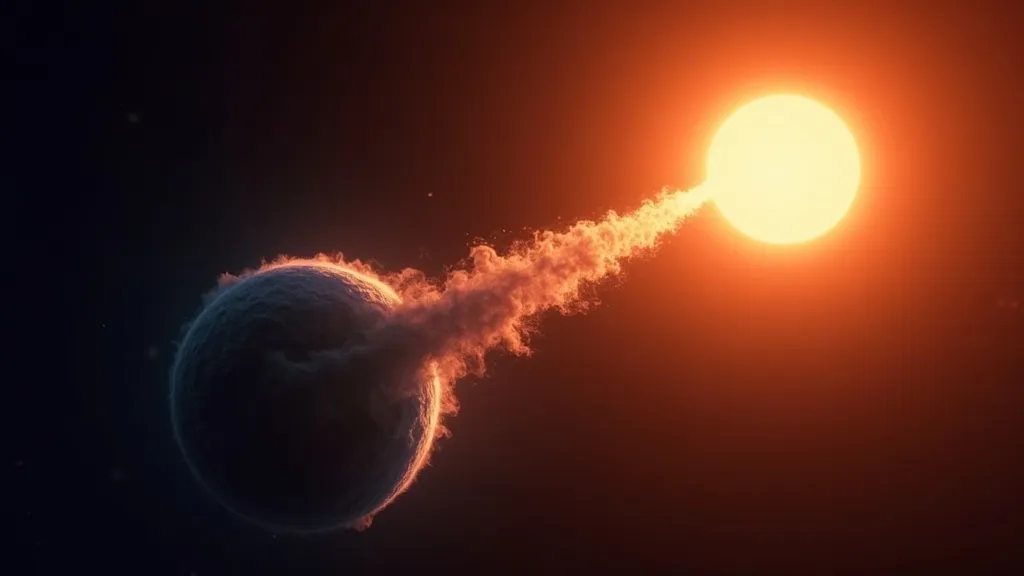
Perhaps the most visually striking feature of 3I/ATLAS is something exceedingly rare in cometary science: an anti-solar tail. Unlike typical comet tails that stream away from the Sun due to solar radiation pressure, this tail actually points toward the Sun.
This isn’t an optical illusion. It occurs when large dust grains ejected from the comet’s sunlit side have enough momentum to overcome the Sun’s radiation pressure. This unusual phenomenon has been observed in only a handful of comets and provides valuable information about the physical properties of the dust grains that make up 3I/ATLAS.
A Window Into Another Star System
The extreme nickel-to-cyanide ratio in 3I/ATLAS—orders of magnitude above what we see in our solar system’s comets—suggests that the environment where this interstellar visitor formed was fundamentally different from the nebula that created our planets.
These differences might reflect:
- The composition of planets that formed around that distant star
- Conditions in the early universe that no longer exist today
- Chemical processes unique to that particular stellar system
In essence, 3I/ATLAS gives us a direct sample of another star’s chemistry without requiring us to travel the vast distances to study it directly—a cosmic delivery service bringing alien material right to our cosmic doorstep.
The Future of Interstellar Astronomy
As astronomers continue tracking this interstellar messenger before it leaves our solar system forever, each new observation helps build a more complete picture of the diversity of chemistry throughout our galaxy.
The upcoming Vera C. Rubin Telescope represents a quantum leap in our ability to discover these cosmic visitors. With its unprecedented wide-field capabilities, it will likely identify many more interstellar objects passing through our solar system, each one offering a glimpse into the chemical makeup of distant stellar nurseries where other worlds are forming.
Expanding Our Understanding of Life’s Potential
Perhaps most profoundly, these cosmic time capsules from other stars are teaching us that the chemistry of our universe may be far more diverse than we once imagined. This expanded understanding of cosmic chemistry directly impacts our search for life beyond Earth.
If star systems can differ so dramatically in their fundamental chemical compositions, then the potential environments where life might emerge could be far more varied than previously thought. Each interstellar visitor like 3I/ATLAS expands our understanding of what’s possible in the universe.
Conclusion: A Brief Window of Opportunity
As 3I/ATLAS continues its journey through our solar system, scientists are racing against time to gather as much data as possible before it returns to the interstellar void, never to be seen again. This fleeting cosmic encounter reminds us of how fortunate we are to witness these rare visitors that connect our solar system to the broader galaxy.
In a very real sense, when we study objects like 3I/ATLAS, we’re reading messages from another sun, another time, and another place—expanding our understanding of our cosmic neighborhood one interstellar visitor at a time.