
Horsehair Worms: Nature's Genetic Hackers Rewriting DNA
Horsehair worms don't evolve mind control—they steal it. These parasites are copying genes directly from their hosts' DNA, building a library of manipulation techniques that's rewriting everything we know about evolution and genetic transfer.
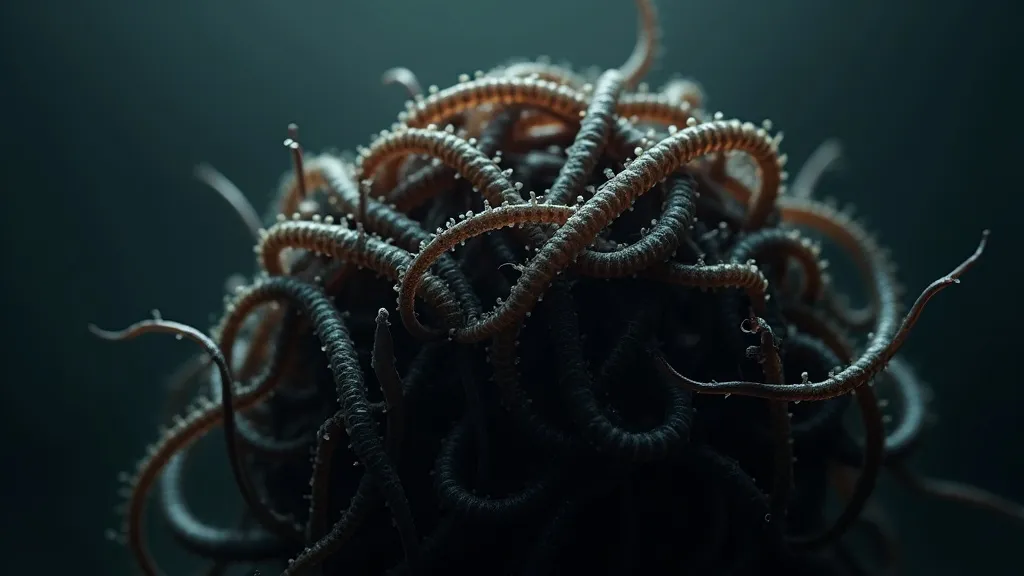
The ancient Greeks told stories of an impossible knot—so intricate and complex that no mortal could ever untangle it. When scientists discovered parasitic worms that twist themselves into elaborate tangles during mating, they named them after that legendary knot: Gordian worms, or horsehair worms.
But the Greeks never imagined the real knot these creatures would tie—one that exists not in their bodies, but deep within their DNA. These parasites aren’t just manipulating their hosts through millions of years of evolution. They’re doing something far more unsettling: they’re stealing genetic code directly from the creatures they infect.
Genetic Plagiarism in Real Time
When a horsehair worm infects a cricket, something extraordinary happens. The worm doesn’t slowly evolve the ability to control its host’s brain over countless generations. Instead, it takes a shortcut that would make any hacker envious: it steals the working instructions directly from the host.
The worm grabs functional genes from the cricket’s own genome—genes that already know how to manipulate insect neurology—and integrates them into its own DNA. Scientists call this process horizontal gene transfer, and it’s not the gradual mutation we learn about in biology class. This is genetic plagiarism happening in real time, copying and pasting code from one species to another.
One Parasite, Dozens of Victims, Countless Stolen Techniques
What makes this even more remarkable is the sheer versatility of these parasites. Horsehair worms don’t just infect one type of host—they target dozens of different species:
- Grasshoppers
- Beetles
- Mantises
- Cockroaches
- Crickets
Each of these insects has a completely different brain structure. Each processes information differently. Each has unique neurological pathways. And yet, somehow, the horsehair worm can hijack all of them.
The secret? The worms aren’t using one universal trick. They’re building an entire library of mind control techniques, each one stolen directly from the species they infect. It’s like a master thief collecting lockpicks specifically designed for every lock they might encounter.
Surgical Precision: Using the Brain’s Own Code Against Itself
The manipulation these worms achieve isn’t crude or random—it’s surgically precise. The worms use their stolen genetic instructions to implement species-specific mind control:
In one species, the worm rewrites how the host interprets polarized light, making the insect irresistibly attracted to water surfaces—even though the insect would normally avoid them.
In another species, it alters the brain’s threat assessment systems, essentially reprogramming the host’s survival instincts so that drowning seems preferable to staying on land.
The worm isn’t randomly breaking the brain or crudely damaging neural tissue. It’s using the brain’s own stolen instructions to trick it into suicide—a manipulation so precise it could only work with insider knowledge.
The Disturbing Discovery That Changes Everything
Recent scientific research has uncovered something even more unsettling about these genetic thieves. The genes horsehair worms use for manipulation didn’t gradually evolve over millions of years. Instead, they’ve been acquiring them from hosts faster than natural selection could possibly work through traditional inheritance.
What does this mean? Parasites might be the most prolific genetic engineers on Earth, moving functional code between species while we’ve been looking the other way, assuming evolution only works through parent-to-offspring inheritance.
The Line Between Species Is Dissolving
The real horror here isn’t just the mind control—it’s the realization that the line between parasite genome and host genome is actively dissolving.
These creatures aren’t separate species playing a simple game of predator and prey. They’re becoming genetic collaborators—without consent, without awareness, and without any of the ethical frameworks we apply to genetic engineering in laboratories.
They’re sharing code, swapping instructions, and building hybrid genomes that blur the boundaries between self and other.
What This Means for Everything We Thought We Knew
If one parasite can do this, we have to ask the uncomfortable question: How many others are quietly rewriting the code of life while we assume evolution only moves through traditional inheritance?
Horizontal gene transfer isn’t some rare anomaly—it might be happening all around us, all the time, in ways we’re only beginning to understand. The tidy evolutionary tree we learned about in school might be more like a tangled web, with genetic information flowing not just down through generations, but sideways across species barriers.
The Knot That Includes Us
The ancient Greeks believed the Gordian knot was impossible to untangle. Alexander the Great supposedly solved the puzzle by cutting through it with his sword—a dramatic solution, but one that destroyed the knot rather than understanding it.
We can’t afford that approach with these genetic puzzles. Because as we dig deeper into the mysteries of horizontal gene transfer and genetic exchange between species, we’re realizing something profound:
The knot includes us.
We’re not separate observers standing outside the tangled web of genetic exchange. We’re part of it. Our own genomes carry the signatures of ancient viral infections, bacterial genes, and genetic material from sources we’re still discovering.
The horsehair worms aren’t showing us something alien and separate from human experience. They’re showing us a fundamental truth about life on Earth: genetic information has always been more fluid, more shareable, and more collaborative than we ever imagined.
And that realization—that the boundaries between species are more permeable than we thought—might be the most important knot we’ll ever try to untangle.
The more we learn about parasites like horsehair worms, the more we realize that evolution isn’t just a slow march of random mutations. It’s also a story of genetic theft, cross-species collaboration, and information exchange that happens on timescales far faster than traditional natural selection. Nature, it turns out, has been hacking genomes long before humans even understood what DNA was.