
First-Ever Photographed Black Hole Caught Launching Massive 3,000-Light-Year Cosmic Jet
The historic black hole from the famous 2019 image is now revealing its most spectacular secret - launching an enormous jet of energy that spans 3,000 light-years across space. Multi-frequency observations are giving scientists unprecedented views of how these cosmic monsters work.
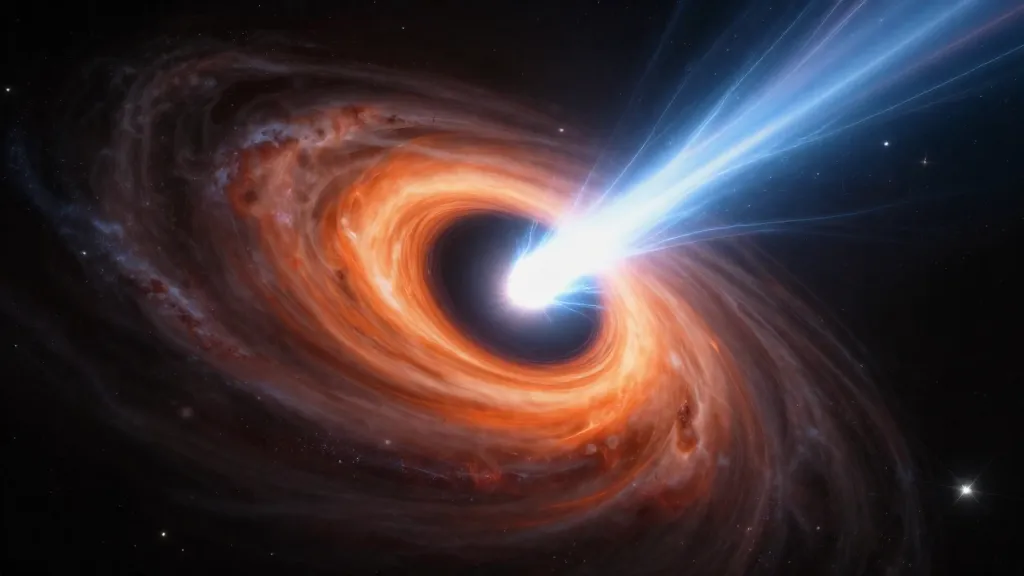
Remember that iconic black hole image that broke the internet in 2019? The fuzzy orange donut that gave us our first glimpse of one of the universe’s most mysterious objects? Well, that same cosmic giant has just revealed something even more mind-blowing – it’s actively launching a colossal jet of energy that stretches an incredible 3,000 light-years across space.
The Black Hole That Changed Everything
The supermassive black hole at the center of galaxy M87 made history when it became the first black hole ever directly photographed by the Event Horizon Telescope. That groundbreaking image showed us the black hole’s “shadow” – the dark region surrounded by the glowing ring of superheated matter spiraling toward oblivion.
But astronomers weren’t content to stop there. They’ve been watching this cosmic behemoth with multiple telescopes across different frequencies of light, and what they’re discovering is rewriting our understanding of how these massive objects work.
A Cosmic Fire Hose of Epic Proportions
The new observations reveal that M87’s black hole is doing something spectacular: launching a jet of plasma and energy that spans roughly 3,000 light-years from end to end. To put that in perspective, that’s about 30 times the distance from our solar system to the nearest star.
This isn’t just any ordinary cosmic phenomenon. Black hole jets are among the most powerful forces in the universe, capable of accelerating particles to nearly the speed of light and influencing the evolution of entire galaxies.
Multi-Frequency Detective Work
What makes these new findings so remarkable is how astronomers are piecing together the complete picture. By observing the black hole across multiple frequencies – from radio waves to X-rays – they’re getting unprecedented views of the jet-launching region itself.
Key observations include:
- Direct imaging of the jet’s connection to the black hole’s immediate vicinity
- Multi-frequency data showing how the jet forms and accelerates
- Evidence of the jet’s interaction with surrounding space
- Detailed views of the “shadow” region where the jet originates
As researchers noted in the recent findings, “It is amazing to see that we are gradually moving towards combining these breakthrough observations across multiple frequencies and completing the picture of the jet launching region.”
Why This Discovery Matters
These observations are helping scientists understand one of astronomy’s biggest puzzles: how do black holes, which trap everything including light, manage to launch these massive jets of material back into space?
The answer lies in the complex physics happening just outside the black hole’s event horizon. The spinning black hole and its powerful magnetic fields work together like a cosmic dynamo, channeling some of the infalling material into these high-speed jets before it can cross the point of no return.
The Future of Black Hole Science
This research represents just the beginning of a new era in black hole astronomy. By combining the imaging capabilities of the Event Horizon Telescope with observations from other instruments, astronomers are building the most complete picture yet of how these cosmic monsters operate.
The same black hole that gave us our first direct look at these enigmatic objects is now teaching us about their most dramatic behavior. From that first historic photograph to these new jet observations, M87’s black hole continues to be the gift that keeps on giving to our understanding of the universe’s most extreme environments.
As technology improves and more telescopes join the effort, we can expect even more spectacular revelations from this cosmic laboratory that’s been performing its high-energy light show for millions of years – we’re just now learning how to watch.