
James Webb Telescope Reveals Black Holes as Cosmic Recyclers—Here's How They Feed
The James Webb Space Telescope has uncovered surprising new insights into how black holes consume and redistribute matter throughout the universe, revealing them as cosmic recyclers rather than simple vacuum cleaners.
You’ve probably heard black holes described as cosmic vacuum cleaners—those mysterious objects that suck up everything in their path and trap it forever. But the James Webb Space Telescope is rewriting that story. Recent observations suggest black holes are far more complex than we thought: they’re not just consuming matter, they’re actively processing and redistributing it throughout the universe. What we’re learning is that black holes function as the cosmos’s ultimate recycling system, and the mechanisms behind this cosmic recycling are only now coming into focus.
Black Holes: From Cosmic Vacuum to Cosmic Recycler
For decades, our mental image of black holes was straightforward and somewhat terrifying—an unstoppable gravitational trap where matter goes in and disappears forever. That picture isn’t wrong, exactly, but it’s incomplete.
The James Webb Space Telescope’s observations are revealing that black holes may be the ultimate cosmic recyclers. Rather than being dead-end cosmic sinkholes, they appear to actively process matter and energy in ways that reshape their surroundings and influence the broader universe. This represents a significant shift in how astronomers understand black hole ecology and their role in cosmic evolution.
How Black Holes Actually Feed
The feeding mechanisms of black holes are more nuanced than simple gravitational capture. As material spirals inward toward a black hole, it doesn’t simply vanish—the process generates enormous energy and creates complex interactions with surrounding matter and radiation.
The Recycling Process
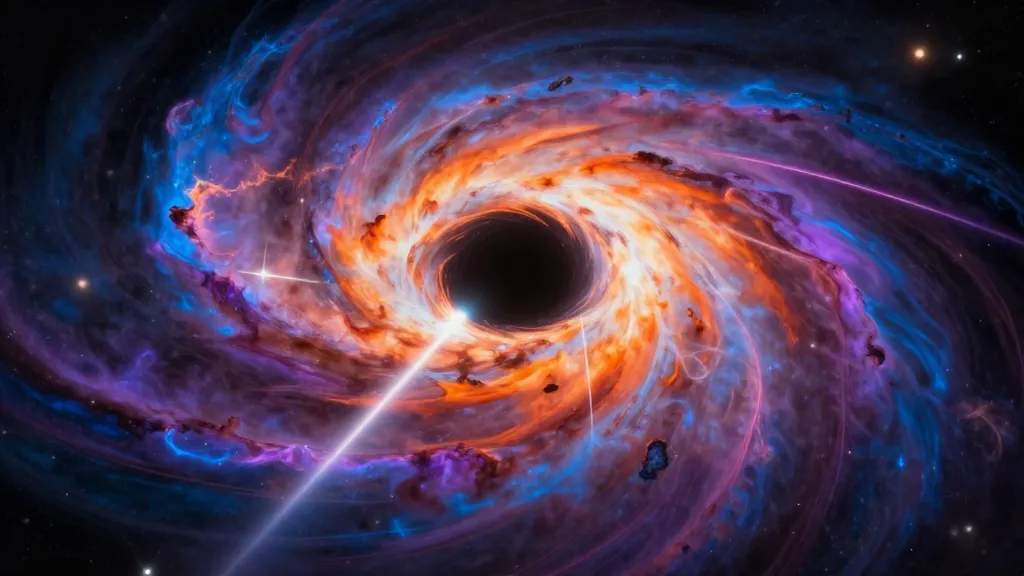
When material approaches a black hole, it forms an accretion disk: a swirling disk of gas, dust, and stellar remnants orbiting at tremendous speeds. This isn’t a quiet process. The friction and compression in this disk heat material to extreme temperatures, causing it to emit powerful radiation and jets of energy outward into space.
What makes this a “recycling” system is that much of this material and energy doesn’t stay trapped. Instead, it gets redistributed back into the surrounding cosmic environment, influencing star formation, galaxy evolution, and the distribution of matter across vast distances.
What to Watch For
As JWST continues its observations, keep an eye on:
- New discoveries about specific black holes and their feeding patterns
- Connections between black hole activity and galaxy formation rates
- Evidence of how black hole jets reshape their cosmic neighborhoods
- Refinements to models of black hole evolution over cosmic time
Reshaping Our Understanding of the Universe
This shift from viewing black holes as cosmic dead-ends to recognizing them as recyclers has profound implications. It suggests that some of the universe’s most extreme objects play an active, constructive role in cosmic processes. Rather than being isolated destructive forces, black holes appear to be integral parts of how the universe regulates itself and distributes matter and energy.
The James Webb Space Telescope’s capabilities have allowed astronomers to observe black hole activity in unprecedented detail, revealing complexity that ground-based observations could never quite capture. As more data comes in, our understanding of these cosmic engines will continue to evolve—and with it, our understanding of the universe itself.