
Scientists Finally Crack the Mystery of Bright Blue Cosmic Flashes Lighting Up Space
Mysterious luminous fast blue optical transients (LFBOTs) that have puzzled researchers for over a decade may finally be explained: extreme tidal disruption events where supermassive black holes shred companion stars. A record-bright example discovered last year is giving scientists unprecedented insight into how these cosmic catastrophes work.
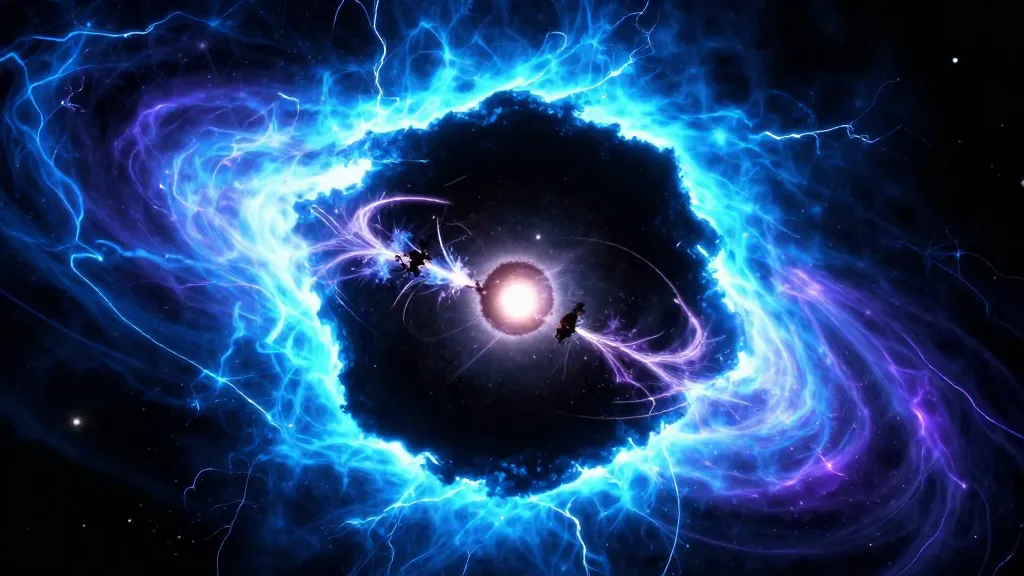
For over a decade, astronomers have been baffled by brilliant flashes of blue light erupting across the cosmos—appearing suddenly, burning with intense brightness, and vanishing just as quickly. These mysterious events, known as luminous fast blue optical transients (LFBOTs), have sparked wild theories ranging from exotic supernovae to bizarre cosmic phenomena. Now, after spotting more than a dozen of these enigmatic bursts, scientists believe they’ve finally cracked the case—and the answer is as violent as space gets.
The Mystery That Stumped Astronomers
When LFBOTs first appeared on astronomical radar, they presented a genuine puzzle. These events produce short, intensely bright flashes of blue light that fade away while leaving behind detectable X-ray and radio emissions. The brief, brilliant nature of the phenomenon made it difficult to study, and explanations ranged from the plausible to the speculative. Scientists proposed everything from unusual supernovae to black holes actively consuming interstellar gas, but none of these theories felt quite right.
The key breakthrough came last year when researchers observed a new example—and it turned out to be the brightest LFBOT ever recorded.
When Black Holes Shred Stars: Extreme Tidal Disruption
The new observations point to a single, catastrophic explanation: extreme tidal disruption events. This occurs when a supermassive black hole encounters a companion star and the black hole’s gravitational pull becomes so intense that it literally tears the star apart.
Picture this: a star orbits too close to a supermassive black hole. The gravitational forces on the near side of the star become dramatically stronger than those on the far side. The difference in pull is so extreme that the star gets stretched like taffy, disrupted at its very core, and ultimately destroyed. The violent process releases tremendous energy in the form of those brilliant blue flashes we’ve been observing.
What This Means for Black Hole Science
The implications of this discovery extend far beyond simply solving a cosmic mystery. According to Raffaella Margutti, an associate professor of astronomy and physics at UC Berkeley, this research offers a completely new window into understanding how supermassive black holes actually form and evolve.
Here’s what observers are focusing on:
- How supermassive black holes grow to their enormous sizes
- The relationship between black holes and their companion stars within galaxies
- The precise locations of these events within host galaxies
- How stellar evolution is affected by nearby black holes
“Theorists have come up with many ways to explain how we get these large black holes,” Margutti noted, referencing observations from gravitational wave detectors like LIGO. “LFBOTs allow you to get at this question from a completely different angle.”
A New Tool for Understanding the Universe
What makes this breakthrough particularly exciting is that LFBOTs provide a fresh perspective on black hole formation and behavior. While scientists have detected massive black holes through various methods, the actual mechanisms behind their formation remain unclear. These tidal disruption events offer direct, observable evidence of black holes in action—literally consuming their stellar companions.
The record-bright example discovered last year has proven invaluable. Its unprecedented brightness allowed researchers to gather detailed observations in multiple wavelengths, from ultraviolet light through the near-infrared spectrum, as well as X-ray and radio emissions. This wealth of data provides an unprecedented view of what happens when a black hole tears a star to pieces.
The Road Ahead
The research has been detailed in two comprehensive papers accepted for publication in The Astrophysical Journal Letters. Scientists are already using these findings to reexamine other LFBOTs and refine their understanding of tidal disruption mechanisms.
As more observations accumulate, researchers hope to answer fundamental questions about black hole formation, the role these cosmic monsters play in galaxy evolution, and the precise conditions that lead to these spectacular cosmic catastrophes. What began as a decade-long mystery may now illuminate some of the universe’s deepest secrets.