
Artemis II: NASA's Historic Moon Mission Launches This February—Here's What Could Go Wrong
After 53 years, four astronauts are set to fly around the moon aboard NASA's Artemis II in February 2026. But the mission faces real unknowns—from a heat shield that showed unexpected damage to 45 minutes of total radio silence near the lunar surface.
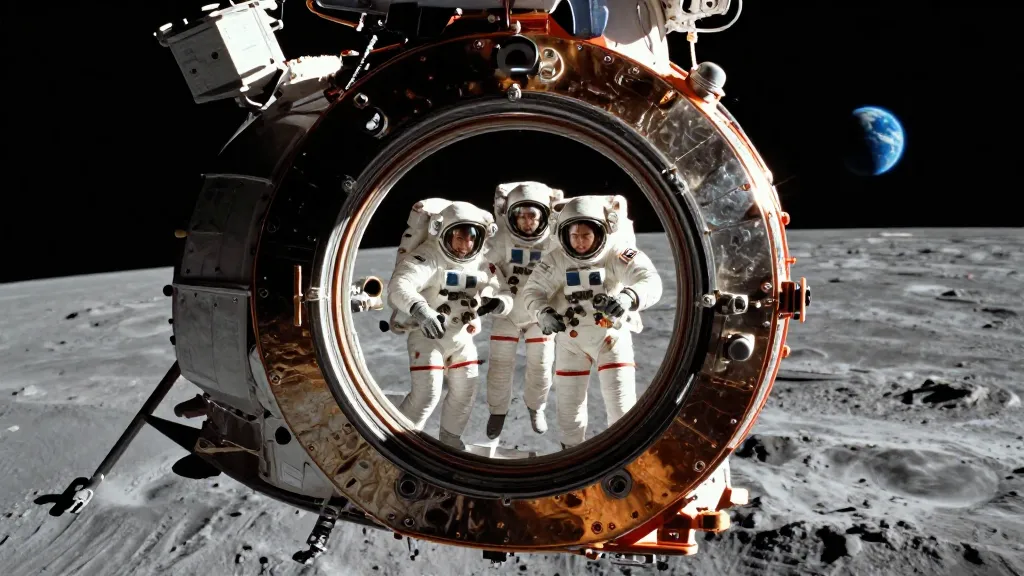
For the first time in over five decades, four elite astronauts are about to do something humanity hasn’t attempted since 1972: venture beyond near-Earth orbit and loop around the moon. NASA’s Artemis II mission is poised to launch as soon as February 2026, and it marks a watershed moment for space exploration. But this isn’t just another space mission. It’s a high-stakes test of untried systems, novel technologies, and humanity’s readiness to return to deep space—with all the genuine unknowns that entails.
The Crew: Four Astronauts, One Historic Journey
Reid Wiseman, Victor Glover, and Christina Koch represent NASA’s finest. But the fourth seat belongs to Jeremy Hansen of the Canadian Space Agency, making this a truly international endeavor. Together, they’ll spend roughly 10 days aboard the Orion spacecraft, traveling 238,900 miles to circumnavigate the moon on a sweeping slingshot trajectory.
“We could see parts of the moon that never have had human eyes laid upon them before,” Koch said during a September news conference.
This isn’t a landing mission—that comes later with Artemis III. Instead, Artemis II serves as a critical validation mission: testing Orion’s life support systems, navigation, and heat shielding in the real environment of deep space for the first time. The crew will also conduct geology observations and carry out biological experiments to understand how the human body responds to deep-space radiation and isolation.
The Heat Shield Problem: NASA’s Lingering Headache
Every spacecraft that returns from space faces the same brutal physics: reentry temperatures exceeding 5,000 degrees Fahrenheit. Orion relies on an ablative heat shield—a special coating that burns away in a controlled manner—to protect the capsule and its crew.
During Artemis I, an uncrewed test flight in 2022, the heat shield showed unexpected damage. Chunks of the ablative material became dislodged, raising red flags across the aerospace community. NASA spent more than a year investigating and implementing fixes.
Officials insist the damage wasn’t catastrophic and that the shield still protected the spacecraft adequately. Lakiesha Hawkins, NASA’s acting deputy associate administrator, stated: “We feel very confident that we are going to be able to bring our crew back safely for Artemis II.”
Still, the issue has drawn scrutiny and criticism. For a mission carrying humans, even “adequate” protection is a conversation worth having.
The 45-Minute Mystery: Radio Silence Near the Moon
Here’s something that keeps mission planners awake at night: when Artemis II is closest to the lunar surface—the most critical part of the trajectory—the crew will lose radio contact with Earth for approximately 45 minutes.
“For the 45 minutes we are closest to the lunar surface, we are also going to be out of contact — we’re going to have an LOS, in NASA terms, a loss of signal,” Glover said in September. “I would love it if the entire world … could come together and just be hoping and praying for us to get that acquisition of signal.”
This communication blackout isn’t a bug—it’s a feature of the mission’s design. The Orion spacecraft’s trajectory brings it around the far side of the moon, where Earth is blocked from view. If something goes wrong during those 45 minutes, mission control can’t help. The crew is on its own.
What to Watch For
- Heat shield performance during reentry – Will the ablative coating hold up under the extreme thermal stress of returning from deep space?
- Life support systems in operation – This is the first crewed test; any malfunction could be critical.
- Communication acquisition after lunar pass – That moment when contact resumes will be watched by millions.
- Crew health and radiation exposure – Baseline data on how humans respond to deep-space radiation environments.
- Orion’s propulsion systems – The spacecraft’s ability to execute course corrections and return safely.
Why This Matters: Geopolitics and the Future of Lunar Exploration
Artemis II isn’t happening in a vacuum. Hawkish lawmakers have made clear that lunar exploration is now a geopolitical imperative, particularly as China’s space program advances rapidly. This mission serves as a pathfinder for Artemis III, which aims to land astronauts at the moon’s south pole region—somewhere no human has ever set foot.
Understanding the limits and capabilities of Orion in deep space is essential to that goal. As Glover emphasized, even missteps on Artemis II would provide valuable data points for humanity’s collective effort to return to the moon and eventually reach Mars.
The Human Element: Training for the Unknown
The Artemis II crew members are far from passive passengers. They’ll carry tools to monitor their cognition, sleep, stress, immune responses, and cardiovascular health. Small chips containing human organ tissue will collect data on how the body responds to deep-space radiation—a question that remains partially mysterious despite the lessons learned from Apollo astronauts.
Jacob Bleacher, NASA’s chief exploration scientist, noted: “The science of Artemis is the science of us. We will be collecting some of the baseline data here on how humans operate when they get away from the Earth.”
On the lunar surface observations, the crew will photograph and analyze geologic features—impact craters, ancient lava flows, and other formations—using their extensive training. This work will directly inform where and how future astronauts explore during Artemis III.
The Bottom Line: Uncertainty Is Part of the Mission
NASA has learned tremendously from Apollo, but Artemis II is fundamentally different. The spacecraft, the rocket, the trajectory, and the radiation environment all present novel challenges. As Jeremy Hansen said during a September news conference: “The most important thing we are working on — refining and honing — is: How do we handle the unknown?”
That’s both the promise and the peril of Artemis II. It’s not a repeat of Apollo. It’s a leap into territory that, while informed by past success, remains genuinely uncertain. In February 2026, four astronauts will strap into a rocket and trust humanity’s best engineering, decades of accumulated knowledge, and each other to navigate that uncertainty. The world will be watching—and hoping for that signal acquisition after those long 45 minutes of silence.