
NASA's Perseverance Rover Finds Strongest Evidence Yet of Ancient Life on Mars
NASA's Perseverance rover has detected complex carbon on a Martian rock surface without drilling, marking the most compelling evidence to date of potential ancient microbial life on the Red Planet.
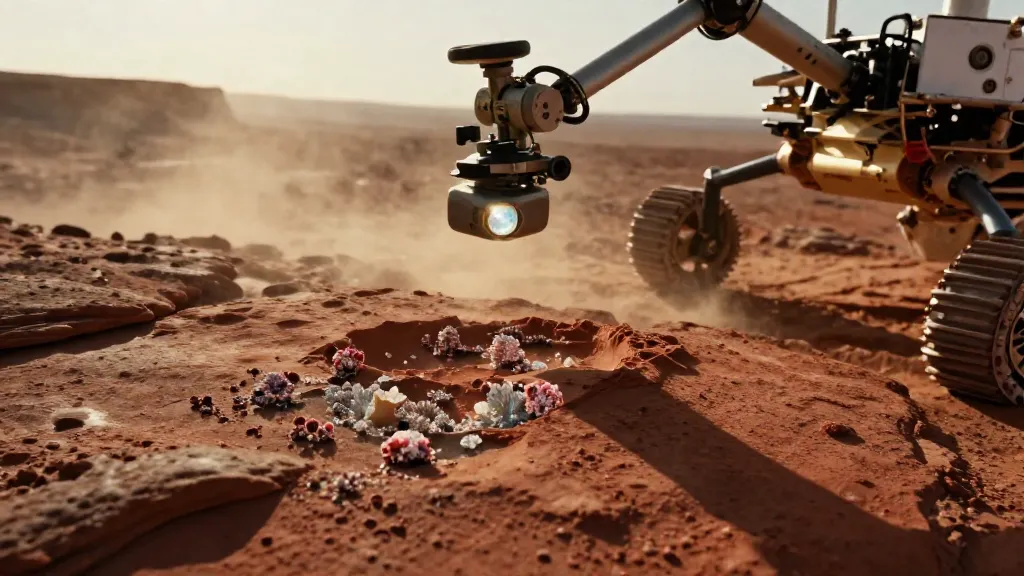
We might not be alone in the universe after all. NASA’s Perseverance rover has just made one of the most tantalizing discoveries in the search for extraterrestrial life: complex carbon signatures on the surface of a Martian rock—without even having to drill or dig. It’s the kind of finding that makes you pause and wonder: could microbial life have thrived on Mars billions of years ago? For the first time, we have what scientists are calling the strongest evidence yet that it might have.
A Discovery That Changes Everything
The Perseverance rover, which has been exploring Mars’s Jezero Crater since 2021, has been equipped with sophisticated instruments designed to detect the chemical fingerprints of ancient life. But this latest discovery is remarkable for a different reason: the complex carbon was found on the bare, exposed face of a rock—no invasive drilling required. This non-destructive detection method makes the finding even more significant, as it suggests that life’s traces may be far more accessible to future exploration than previously thought.
Complex carbon compounds are the building blocks of life as we know it. While carbon exists throughout the universe in many forms, the specific arrangement and complexity of these molecules can hint at biological origins. Perseverance’s instruments detected these signatures with enough clarity that researchers are now calling it the strongest evidence to date of potential ancient microbial life on Mars.
Why This Matters
The implications are staggering. Mars was once a warmer, wetter world—a place where life could potentially have taken hold. If microbes did exist there, finding their chemical traces could answer one of humanity’s most profound questions: Are we alone?
This discovery also signals a shift in how we search for life beyond Earth. Rather than relying solely on drilling and sample collection, rovers can now identify promising signs of ancient life from the surface itself. That means:
- Future missions can be more efficient in identifying high-priority samples
- We may find evidence of ancient life without disturbing delicate geological structures
- The search for biosignatures can expand to more locations on Mars and beyond
What to Watch For
As this story develops, keep an eye on these key points:
- How other scientists peer-review and validate these findings
- Whether additional Martian rocks show similar carbon signatures
- Plans for future missions to collect and return samples for deeper analysis
- Updates on what specific types of complex carbon were detected
The Road Ahead
It’s crucial to emphasize that complex carbon, while compelling, is not definitive proof of ancient life. Abiotic (non-biological) processes can also produce complex carbon compounds. That’s why the scientific community approaches such findings with measured enthusiasm—excitement tempered by the rigorous skepticism that good science demands.
However, this discovery represents a genuine milestone. It brings us closer to answering whether life emerged elsewhere in our solar system, and it demonstrates that the tools and methods we’ve developed can detect the subtle signatures of ancient biology. Each finding like this one narrows the gap between speculation and evidence.
For now, Perseverance continues its methodical exploration of Mars, armed with new confidence that the strongest clues to ancient Martian life may be waiting just beneath the rust-colored dust—or even visible on the surface itself.