
Harvard Scientist Claims 'Alien Battleship' Approaching Earth—NASA Disagrees
A Harvard astrophysicist warns a mysterious comet called 3i/ATLAS could be extraterrestrial technology, while NASA and other scientists insist it's just a natural cosmic object. The object reaches its closest point to Earth on Friday.
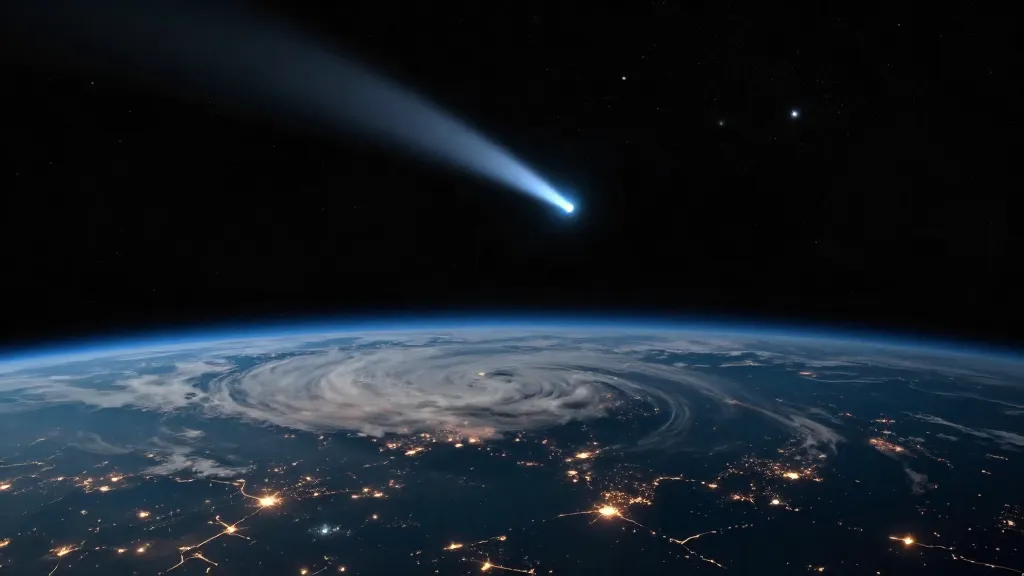
A mysterious object hurtling through our solar system at 130,000 mph has ignited one of the most contentious debates in recent astronomy. While nearly every scientist agrees it’s simply a comet, one prominent Harvard astrophysicist is warning the world to consider a far more dramatic possibility: we might be receiving an interstellar visitor of artificial origin. As 3i/ATLAS reaches its closest point to Earth on Friday, the clash between caution and consensus has never been more intense.
The Object That Started It All
3i/ATLAS was first spotted in July as a faint dot of light against the cosmic backdrop. Since then, it has moved with remarkable speed through our solar system, passing Mars in early October before briefly disappearing behind the sun. The object will sweep past Earth at a distance of roughly 170 million miles—about twice as far as the sun—before continuing toward Jupiter and eventually fading from view.
US and European space agencies have trained cameras from a dozen spacecraft on the object, gathering unprecedented amounts of data. Scientists estimate the comet is around eight billion years old, making it twice as ancient as our entire sun and solar system. By all conventional measures, it appears to be a cosmic fossil: a remnant from the formation of some distant star in the galaxy.
The Harvard Challenge
Enter Professor Avi Loeb of Harvard University, who has thrown down a provocative gauntlet. While acknowledging the mainstream view, Loeb insists we cannot—and should not—dismiss the possibility that 3i/ATLAS could be extraterrestrial technology.
His reasoning rests on several observations:
- The unusual tail: Images of the object reveal a distinctive tail that Loeb suggests could originate from a propulsion system
- Nickel in the gas cloud: The presence of this metal in the object’s atmosphere might indicate metal mining operations on its surface
- The trajectory alignment: The path of 3i/ATLAS aligns suspiciously well with the orbits of planets in our solar system, a coincidence Loeb argues is too unlikely to be random
Loeb frames his concern as a “black swan event”—something highly unlikely but with potentially catastrophic consequences. “When there are implications to society, we must consider even an unlikely event and collect as much data as possible to convince us otherwise,” he told Sky News. He even invoked a stark metaphor: “Alien technology is a potential threat because when you go on a blind date of interstellar proportions, you never know whether you have a friendly visitor as your dating partner or a serial killer.”
The Scientific Pushback
NASA and other space agencies are unequivocal in their response. Amit Kshatriya from NASA stated plainly: “This object is a comet. It looks and behaves like a comet. All evidence points to it being a comet.”
Professor Chris Lintott from the University of Oxford was even more dismissive, comparing Loeb’s theory to claiming the moon is made of cheese. He explained that the comet’s changing color and brightness can be easily accounted for by the sun heating pockets of ice and various materials the object has accumulated during its journey through space.
“There is nothing this thing has done that we haven’t seen elsewhere,” Lintott said. “It is just nonsense.”
What to Watch For
As 3i/ATLAS makes its closest approach, observers on both sides of this debate will be scrutinizing:
- Any unexpected changes in the object’s trajectory or acceleration
- Unusual electromagnetic signatures or radiation patterns
- Structural features visible in high-resolution imaging from space telescopes
- The object’s behavior as it passes through different regions of our solar system
The Bigger Argument
Beneath the surface of this specific debate lies a deeper philosophical disagreement about how science should operate. Loeb has accused his colleagues of intellectual arrogance, suggesting they’ve made up their minds without remaining open to alternative explanations.
“At the foundation of science is the humility to learn,” he argued. “It’s not the arrogance of expertise.”
Lintott countered that unfounded speculation can actually be dangerous. He noted that while searching for signs of intelligent life in the cosmos is a worthwhile endeavor, it must begin with objects that genuinely exhibit odd characteristics. “This thing is not odd,” he insisted.
This isn’t Loeb’s first foray into controversial cosmic claims. In 2017, he made similar arguments about Oumuamua, another interstellar object that passed through our solar system, suggesting it too might be artificial in nature.
The Friday Moment
As 3i/ATLAS reaches its closest point to Earth this week, the scientific community will be watching intently. The data being collected by spacecraft and ground-based observatories may not settle the debate entirely—Loeb’s supporters will likely argue that absence of evidence isn’t evidence of absence—but it will certainly add to our understanding of this intriguing visitor.
Whether 3i/ATLAS proves to be merely an ancient cosmic wanderer or something far more extraordinary, the discussion it has sparked reminds us that science thrives on questioning assumptions. The challenge lies in distinguishing between healthy skepticism and unfounded speculation—a line that reasonable people, it seems, continue to disagree about.