
James Webb Reveals How Our Sun Will Die—And It's Creating Life
The James Webb Space Telescope captured stunning new images of the Helix Nebula, showing how a dying sun-like star enriches the galaxy with elements essential for life. This breathtaking preview of our sun's future reveals the beautiful cosmic cycle of death and renewal.
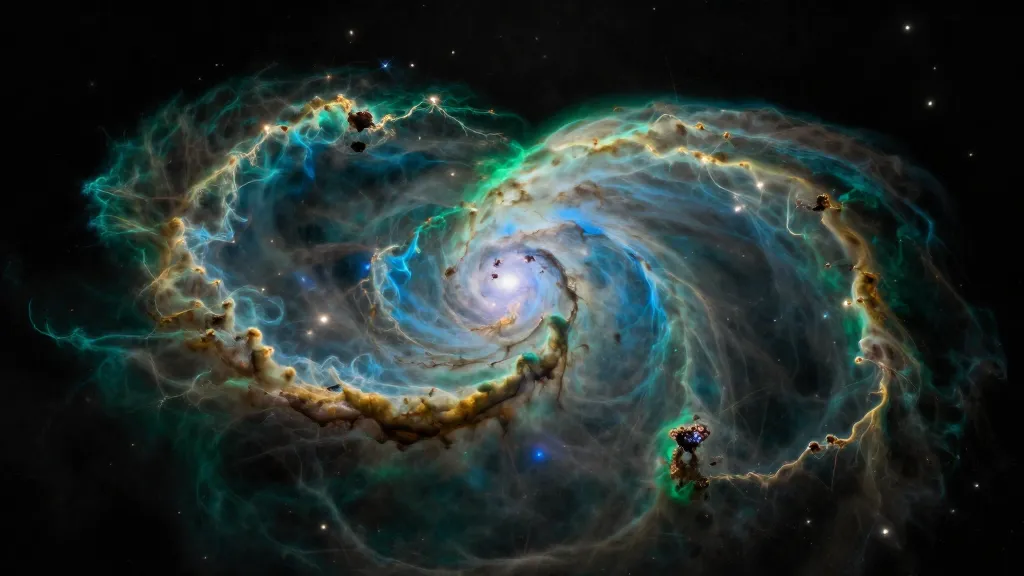
The James Webb Space Telescope has just delivered what might be the most profound preview of humanity’s cosmic future—and it’s absolutely breathtaking. In a stunning new image of the Helix Nebula, often called the “Eye of God,” we’re witnessing exactly how a star like our sun will meet its end, transforming into a spectacular cosmic factory that creates the very elements necessary for life itself.
A Dying Star’s Beautiful Legacy
The Helix Nebula represents one of the most magnificent examples of stellar death in our galaxy. What James Webb has captured isn’t just destruction—it’s creation on an unimaginable scale. As this sun-like star reaches the end of its life cycle, it’s ejecting its outer layers into space, enriching the surrounding cosmic environment with elements that will eventually become the building blocks for new worlds and potentially new life.
The telescope’s unprecedented infrared vision has revealed intricate structures within the nebula that were previously hidden from view. These delicate, almost ethereal formations show us the complex processes occurring as a dying star sheds its material into the cosmos.
The Science Behind the Spectacle
When stars like our sun exhaust their nuclear fuel, they don’t simply vanish. Instead, they undergo a remarkable transformation that benefits the entire galaxy. Reports suggest that during this process, the dying star creates and disperses crucial elements throughout space.
What Makes This Discovery Special
The James Webb telescope’s advanced capabilities have allowed astronomers to peer deeper into the Helix Nebula than ever before, revealing:
- Previously unseen structural details within the nebula
- Evidence of how stellar death enriches galactic chemistry
- Intricate patterns formed by the dying star’s expelled material
- New insights into the cosmic recycling process
Our Sun’s Distant Future
While this cosmic drama won’t unfold for our sun for billions of years, the Helix Nebula offers a preview of what awaits our own stellar neighborhood. The process captured in these images represents the natural lifecycle of sun-like stars—a cycle that has been enriching our galaxy with life-supporting elements for billions of years.
The Cosmic Cycle of Renewal
Perhaps the most remarkable aspect of this discovery is how it illustrates the universe’s capacity for renewal. What appears to be an ending is actually a beginning—the death of one star becomes the foundation for countless future possibilities. The elements being scattered by this dying star may one day become part of new planetary systems, and potentially, new forms of life.
The James Webb telescope continues to revolutionize our understanding of stellar processes, providing unprecedented views of cosmic phenomena that were once beyond our reach. This latest image of the Helix Nebula stands as a testament to both the power of human ingenuity in space exploration and the beautiful complexity of the universe we inhabit.
As we gaze upon this “Eye of God,” we’re not just seeing the end of a star—we’re witnessing the eternal process through which the cosmos creates the conditions for life itself to flourish throughout the galaxy.