
Mars Was Once a Striking Blue Planet With Oceans, Scientists Reveal
New research reveals Mars wasn't always the red desert we know today—it was once a stunning blue planet covered in glistening lakes, rivers, and vast oceans. Scientists have determined the dramatic extent of ancient Martian water that transformed our neighboring world.
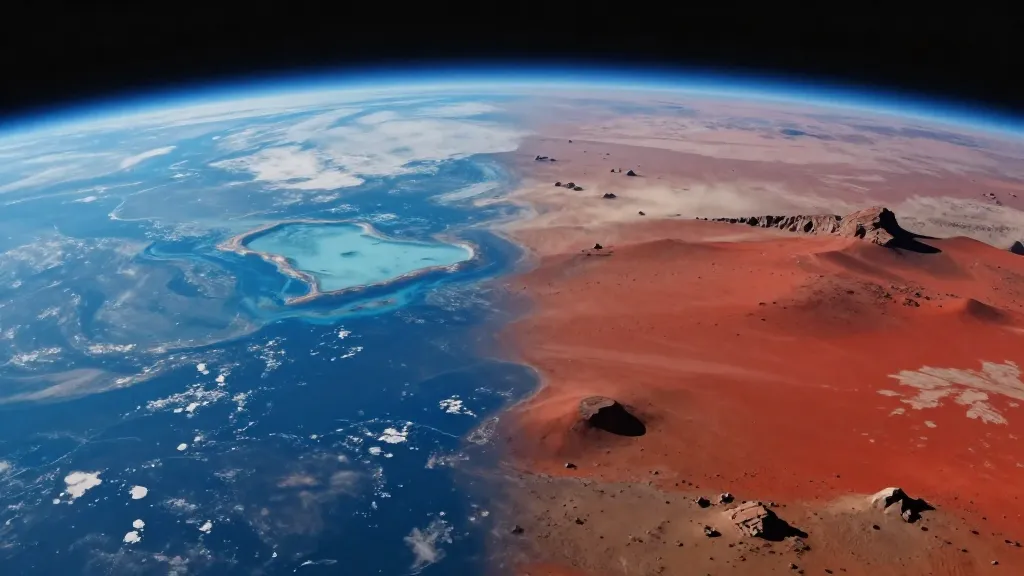
Imagine looking up at Mars in the night sky and seeing not the familiar rusty red dot we know today, but a brilliant blue marble glistening with oceans, rivers, and lakes. Scientists have now revealed the stunning extent to which our neighboring planet was once awash with water—transforming our understanding of Mars from a barren wasteland to a lost aquatic world that rivals Earth’s own beauty.
The Red Planet’s Hidden Blue Past
Mars is absolutely dripping with evidence of its watery history, according to recent scientific analysis. What we see today as a dusty, rust-colored desert was once a striking blue planet that bore little resemblance to the world we observe through telescopes.
The transformation from blue to red represents one of the most dramatic planetary changes in our solar system’s history. Where ancient Martian skies once reflected off vast ocean surfaces, today only dry riverbeds and mineral deposits remain as ghostly reminders of the planet’s aquatic past.
Mapping Ancient Martian Waters
Scientists have been piecing together the remarkable scope of Mars’ former water coverage through careful analysis of geological features and surface compositions. The evidence points to a planet that hosted:
- Glistening lakes scattered across the surface
- Snaking river systems carving through the landscape
- Vast oceans that may have covered significant portions of the northern hemisphere
- Complex water cycles that sustained liquid water for extended periods
These findings suggest Mars once possessed the kind of dynamic water systems that make Earth so unique in our solar system today.
What Turned Blue Mars Red?
The transition from a blue, water-rich world to the red desert we see today represents a catastrophic planetary transformation. While the exact mechanisms remain under investigation, scientists point to several key factors that likely contributed to Mars losing its water and atmosphere over billions of years.
The planet’s smaller size and weaker magnetic field made it more vulnerable to solar radiation stripping away its atmosphere. As the protective atmospheric blanket thinned, liquid water could no longer remain stable on the surface, eventually evaporating into space or freezing into underground ice deposits.
Implications for Life Beyond Earth
This dramatic reframing of Mars’ history has profound implications for our understanding of planetary evolution and the potential for life beyond Earth. A blue, ocean-covered Mars would have provided the stable liquid water environment that scientists consider essential for life as we know it.
The discovery raises tantalizing questions about what kinds of life might have flourished in those ancient Martian seas. If microbial life did emerge during Mars’ blue period, traces of that biological activity might still be preserved in the planet’s geological record, waiting to be discovered by future missions.
The Search Continues
As robotic explorers continue to analyze Martian rocks and soil, each new discovery adds another piece to the puzzle of Mars’ aquatic past. The planet’s transformation from blue to red serves as both a cautionary tale about planetary change and a source of hope that life might once have thrived much closer to home than we ever imagined.
Understanding how Mars lost its oceans also provides valuable insights into planetary climate systems and the delicate conditions that allow worlds like Earth to maintain their life-supporting environments over geological time scales.