
NASA's Bennu Asteroid Contains All Chemical Ingredients for RNA Life—Here's Why That Matters
Samples from NASA's Bennu asteroid reveal every chemical building block needed to construct RNA, suggesting life's molecular ingredients may have been delivered to Earth from space billions of years ago.
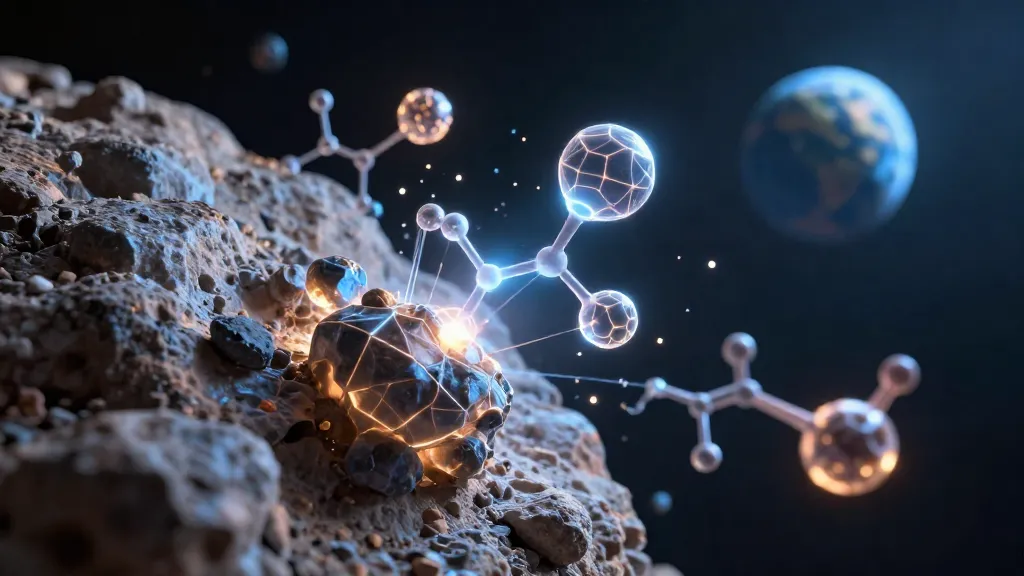
Scientists examining samples returned from asteroid Bennu just made a discovery that could fundamentally reshape how we think about life’s origins: the asteroid contains every single chemical ingredient needed to build RNA. Not most of them. All of them.
This isn’t theoretical speculation or hopeful inference. Researchers have now identified ribose and glucose in the Bennu samples—and when combined with phosphate and RNA nucleobases already detected in the same material, the picture becomes startlingly complete. The asteroid essentially carried a molecular instruction manual for one of life’s most essential molecules.
The Chemistry Inventory of the Early Solar System
What makes this finding so striking is its completeness. For decades, scientists have suspected that asteroids might have delivered some organic compounds to Earth billions of years ago. But finding all the ingredients in one place—in material that’s been preserved since the formation of our solar system—is something else entirely.
Think of it like discovering a fully stocked hardware store floating through space. Bennu isn’t just carrying a few tools; it’s carrying the entire toolkit needed to assemble RNA, one of the molecules that sits at the intersection of chemistry and biology.
What to Watch For
- Further analysis of Bennu samples — researchers are likely to continue examining the asteroid material for additional organic compounds
- Confirmation of findings — peer-reviewed publication of these results will be crucial for scientific validation
- Implications for other asteroids — whether similar chemistry appears in other near-Earth asteroids and meteorites
Panspermia Gets a Chemistry Upgrade
The concept of panspermia—the idea that life’s building blocks arrived on Earth from space—has long occupied an uncomfortable middle ground. It wasn’t quite science fiction, but it lacked the kind of hard chemical evidence that typically convinces skeptics.
Bennu changes that calculation. This asteroid sample becomes less like a single curiosity and more like a chemistry inventory from the early solar system itself. If Bennu carried these ingredients, and if similar asteroids bombarded the young Earth, then the molecular stage for life’s emergence was quite literally set from above.
Why This Matters Beyond the Headlines
The Bennu discovery doesn’t answer the fundamental question of how life began—but it does eliminate one major puzzle piece from the mystery. It shows that the universe didn’t require some improbable chemical accident confined to Earth’s primordial soup. Instead, the molecular ingredients were already present in the materials that built our planet.
For researchers studying astrobiology and the origins of life, this shifts the conversation. Instead of asking “Could these chemicals have arrived on Earth?”, the question becomes “Given that these chemicals were delivered, how did they assemble into the first living systems?”
It’s a subtle but profound difference—one that moves panspermia from speculative hypothesis toward something grounded in observable chemistry.