
High-Speed Train Kills Seven Elephants in India—Including Calves—in Rare Corridor Tragedy
A Delhi-bound express train struck a wild elephant herd crossing tracks in Assam, killing seven animals including calves in an area not designated as a safe crossing. The collision derailed five carriages but left all passengers unharmed.
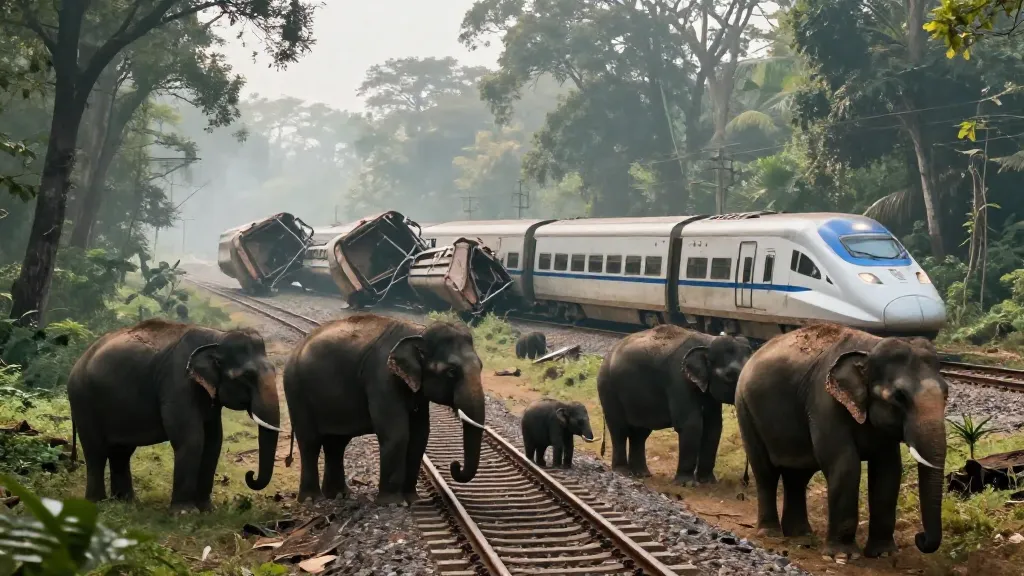
A high-speed express train bound for Delhi struck a wild elephant herd crossing railway tracks in Assam early Saturday morning, killing seven animals including young calves in what authorities are calling a tragic collision in a region not designated as a safe wildlife crossing. The impact was violent enough to derail five passenger carriages, yet miraculously, all passengers and staff aboard walked away unharmed. The incident has reignited urgent questions about India’s rapid rail expansion and whether the country’s infrastructure development can coexist with the survival of its most iconic—and vulnerable—wildlife.
A Preventable Tragedy in Elephant Country
The collision occurred in Hojai district in Assam state, a region that is home to nearly 6,000 wild Asian elephants—one of India’s largest concentrations. According to the Northeast Frontier Railway, the train driver spotted dozens of elephants on the tracks ahead and immediately engaged emergency braking. But the train’s momentum was too great. Some of the herd was struck before the express could come to a complete stop.
Among the seven killed were multiple calves, suggesting a family group was attempting to cross together when the train arrived. A eighth calf was injured in the collision. Railway officials later examined the bodies of the dead elephants and arranged for their burial.
What makes this tragedy particularly stark is the location: the Northeast Frontier Railway confirmed that Saturday’s incident happened at a spot that was not a designated elephant corridor. This detail cuts to the heart of the growing tension between India’s transportation ambitions and wildlife protection.
The Infrastructure-Wildlife Collision
India is in the midst of an aggressive rail expansion program, modernizing and upgrading tracks across the country to support faster, more frequent service. Assam, with its dense elephant population and extensive rail networks, sits at the intersection of these competing priorities.
What to Watch For:
- Whether Indian Railways will designate additional wildlife corridors in Assam and other high-elephant-density regions
- Implementation of early-warning systems or wildlife detection technology along existing tracks
- Coordination between conservation authorities and railway planners on route planning
- Future incidents and whether they trigger policy changes
Local railway tracks in Assam are frequently crossed by elephant herds as the animals move between habitat areas. The problem is that not all crossing points are officially recognized or equipped with safety measures. Saturday’s collision happened at one of these undesignated locations—a gap in infrastructure planning that cost seven elephants their lives.
Why Designated Corridors Matter
A designated wildlife corridor is more than symbolic. It signals to railway authorities where to install warning systems, reduce speed limits, and coordinate with conservation teams. It allows elephants to follow ancestral migration routes without the constant threat of collision. And it gives planners a clear mandate: this is where humans must accommodate wildlife, not the other way around.
Reports suggest that without formal designation, railway operators have little incentive to modify operations or invest in protective infrastructure at crossing points. The result is a patchwork of safe and unsafe passages—a lottery that wild animals lose every time they cross the tracks.
The Broader Pattern
This is not India’s first train-elephant collision, nor will it be the last without significant intervention. As rail networks expand into wildlife-rich regions, similar incidents are likely to increase. Assam’s elephant population is particularly vulnerable because the state’s geography and human development have already fragmented much of their habitat. The railway becomes yet another barrier, yet another threat.
Conservation observers note that preventing these deaths requires action at multiple levels: railways must identify and protect crossing points; state governments must enforce wildlife protection regulations; and planners developing new rail routes must conduct thorough environmental assessments before construction begins.
A Path Forward
The collision also reveals the human cost of poor planning. While passengers on Saturday’s train escaped injury, the derailment of five carriages could easily have resulted in casualties. Better wildlife management on railways isn’t just about saving elephants—it’s about protecting the people traveling on these routes as well.
In the days following the incident, train cancellations and diversions disrupted service across the region, a reminder that wildlife and human infrastructure are inextricably linked. When one fails, both suffer.
The question now is whether this tragedy will catalyze change. Will Indian Railways work with conservationists to map and protect elephant corridors across Assam and beyond? Will new trains be designed or operated differently in wildlife-rich zones? Or will Saturday’s seven dead elephants become just another footnote in the long, preventable conflict between development and nature?
The answers will determine whether future herds can cross these tracks safely—or whether more families will be torn apart by the collision of progress and survival.